Mind Honey Pro Official Website › Blog › Thirty Capsules In A Bottle Called 60
Thirty Capsules In A Bottle Called 60 Pro
The largest number on the front of this bottle is part of its name. The count is printed smaller, twice, and the regulated panel agrees with the smaller number. Here is how that happens, why it happens more often than it should, and the five-second reading that settles it on any bottle.
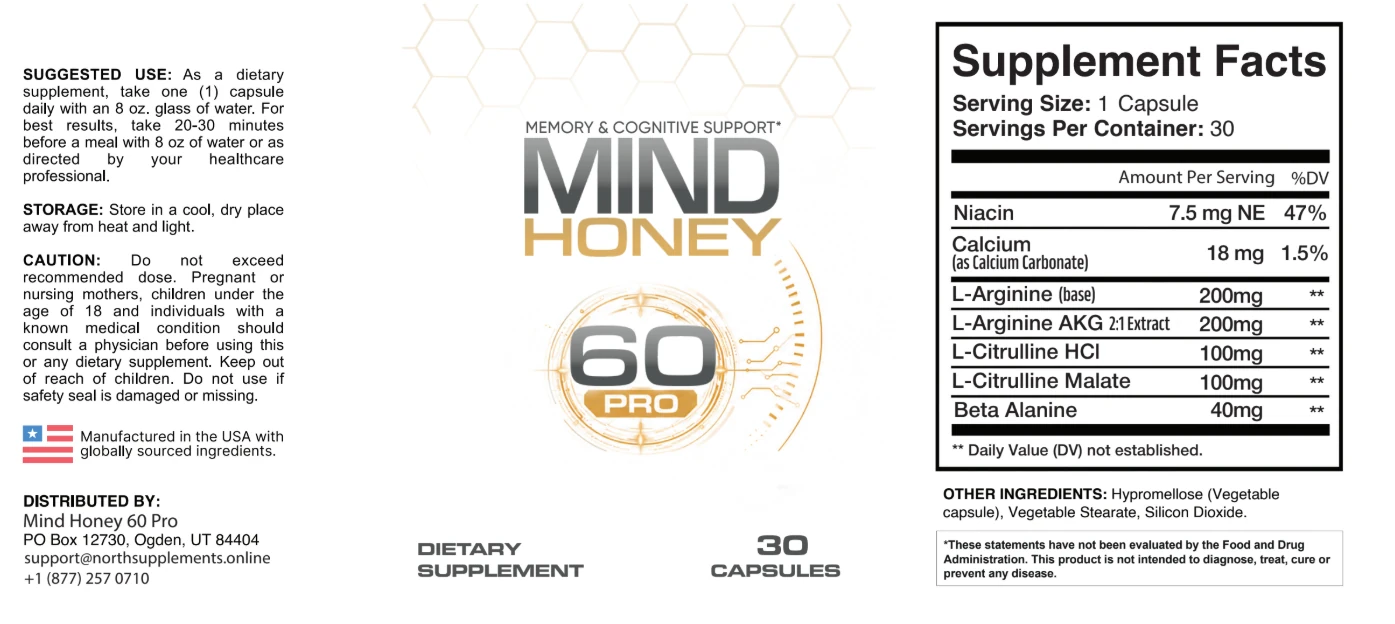
- The bottle holds 30 capsules and the Supplement Facts panel says so.
- The 60 belongs to the product name, which is styled MIND HONEY 60 PRO.
- The distributor company is also called Mind Honey 60 Pro, which is why the number appears twice.
- Serving size is one capsule, so 30 servings is 30 days.
- Both of the seller's own marketing graphics print 30 CAPSULES along the foot.
- On any bottle, Servings Per Container multiplied by Serving Size is the only count that is regulated.
What the front of the bottle says
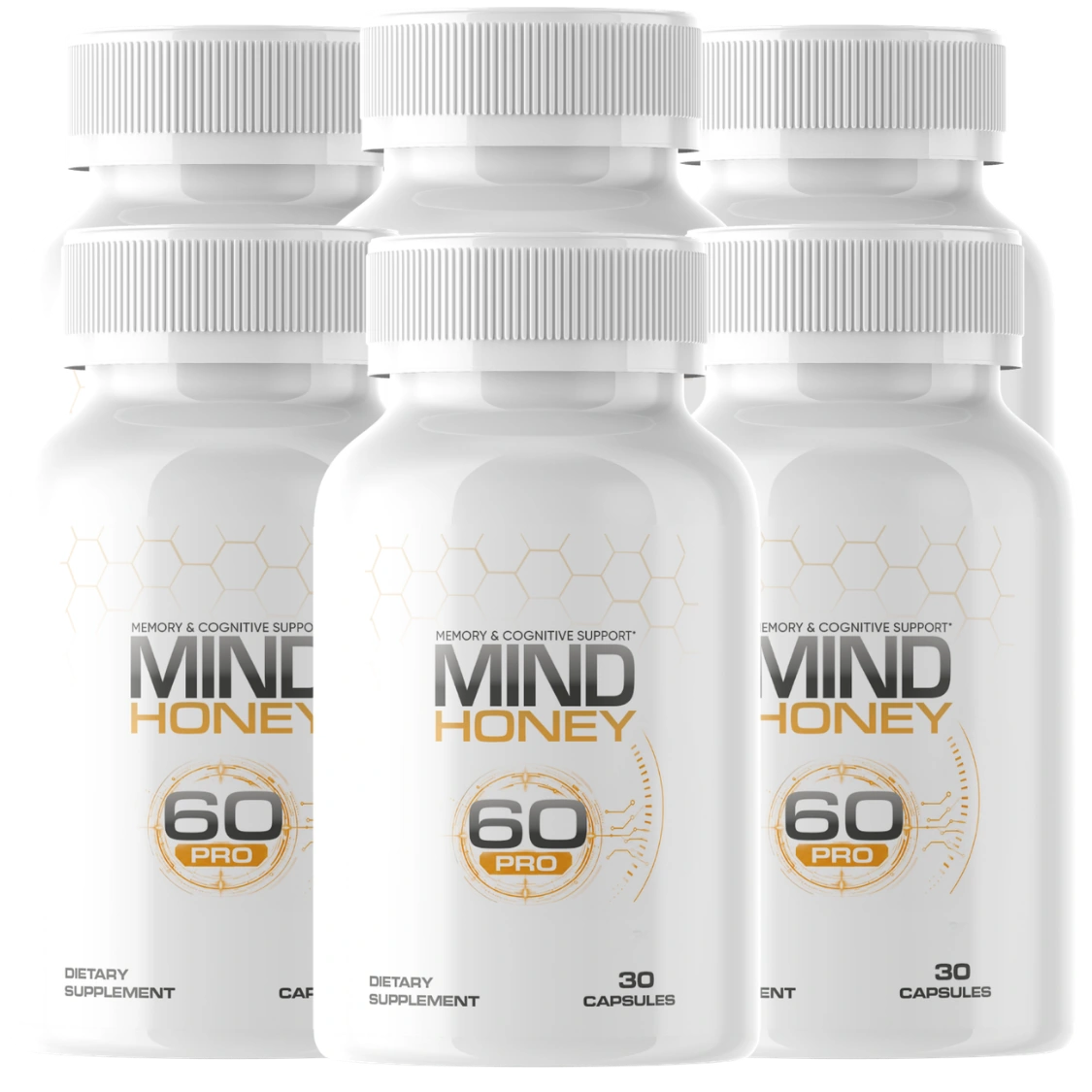
Two numbers sit on the front of this pack and they are printed at wildly different sizes. MIND HONEY 60 PRO runs across the label in the largest type on the bottle. Underneath, in type a fraction of the size, it reads 30 CAPSULES.
A shopper reading at arm's length takes in the first and not the second, which is how the question arises at all. Nobody is being told the bottle holds sixty capsules; the bottle is simply called something with a sixty in it, and the eye does the rest.
Why the name carries a number
Numbers inside supplement names are a convention, and they usually started life meaning something. A strength, a ratio, a formula revision, a count from an earlier pack size. Once a name is printed on a hundred thousand labels it stops being a description and becomes an identity.
Here the number travels further than usual, because the company printed under Distributed By is itself called Mind Honey 60 Pro. So the 60 appears twice on the back of the bottle as well, in a company name rather than in a quantity.
What the regulated panel says
The Supplement Facts panel is not marketing. It is a declaration the manufacturer is committed to under federal labelling rules, and it carries two lines that settle a count between them: Serving Size and Servings Per Container.
On this bottle they read one capsule and 30. Thirty servings of one capsule each is thirty capsules, and the small line on the front agrees with it. So does every other surface the seller prints.
| Where the number appears | What it reads | What it is |
|---|---|---|
| The front of the bottle, large | MIND HONEY 60 PRO | The product name, styled |
| The front of the bottle, small | 30 CAPSULES | The count |
| The Supplement Facts panel | Servings Per Container: 30 | The regulated figure |
| The panel header | Serving Size: 1 Capsule | One capsule is one serving |
| The distributor line | Mind Honey 60 Pro | The company name, carrying the same 60 |
| The seller’s ingredient graphic | 30 CAPSULES along the foot | Marketing, agreeing |
| The seller’s four-step graphic | 30 CAPSULES along the foot | Marketing, agreeing |
Seven surfaces. Two carry a 60 and five carry a 30, and the two that carry a 60 are both names.
Read that table and the pattern is plain. Every surface that states a QUANTITY says 30. Both surfaces that carry a 60 are naming something rather than counting it.
Why a number inside a name is not a count
The distinction matters because the two kinds of number are governed differently. A count on a panel is a regulated declaration. A number inside a brand name is a trademark, and no rule requires it to describe the contents.
That is not a loophole anyone invented for this product. It is how names work across every shelf in a supermarket, and the reason nobody expects a chocolate bar with a number in its name to contain that many of anything.
- A number in the name sits in the largest type and is the least reliable figure on the pack.
- A count on the front is reliable and is printed small.
- Servings Per Container on the panel is the regulated figure and governs everything.
- A company name can carry a number too, which is what doubles the confusion here.
- Marketing graphics are not the panel, so when they agree with it that is a check rather than a source.
What thirty capsules means in practice
The suggested use on this label is one capsule daily with an 8 oz glass of water, 20 to 30 minutes before a meal. One a day against thirty capsules is thirty days, which makes a bottle exactly a month and makes the arithmetic on a multi-bottle pack trivial.
- Two bottles is 60 capsules and 60 days.
- Three bottles is 90 capsules and 90 days, which is twelve weeks and change.
- Six bottles is 180 capsules and 180 days, which is half a year.
Those spans are worth holding on to for a reason that has nothing to do with the label. The published human research behind compounds of this kind is measured in weeks and months: the one randomised cognition trial on oral L-arginine ran 30 days, and the longer trials on this shelf ran twelve weeks. A bottle is one month of a test that takes three.


Order Mind Honey Pro with the count settled
Thirty capsules a bottle, one a day, and 180 days from the date of purchase to change your mind. The panel, the front of the bottle and both seller graphics all print the same figure.
Two bottles $158 · six bottles $294 · 180-day money-back guarantee
Order Mind Honey Pro On The Official WebsiteOne capsule a day · 30 per bottle · lot MIN-26/TH-5324
The five-second reading, on any bottle
This is a transferable skill and it is worth more than the answer to this particular question. Any supplement bottle can be resolved by reading two lines at the top of its panel in the right order.
| What to read | Where it is | Why this one settles it |
|---|---|---|
| Servings Per Container | Top of the Supplement Facts panel | It is the regulated figure and it is the one a manufacturer is committed to |
| Serving Size | Directly above it | A container of 60 servings at two capsules a serving holds 120 capsules, not 60 |
| The count on the front | Usually small, near the bottom | It should agree with the panel. Where it does not, the panel governs |
| The daily instruction | Under SUGGESTED USE on the back | Servings per container divided by servings per day is how long a bottle lasts |
| The product name | The largest type on the pack | Numbers inside a name are styling. They are the least reliable figure on the bottle |
Five readings in the order that resolves a count fastest on any supplement bottle.
The trap the table is built to avoid is the two-capsule serving. A container advertising 60 servings at two capsules each holds 120 capsules and lasts 60 days; a container of 60 capsules at two a day lasts 30. Those two bottles look identical on a shelf and differ by a factor of two in what they cost per day.
How often this happens elsewhere
Often enough that the reading above is worth learning. Three patterns account for most of it.
The number that used to be a count
A product launched at 60 capsules, then changed pack size, and kept the name because the name had equity. The old figure survives on the front of a bottle that no longer holds it.
The number that is a strength
A botanical extract ratio, a milligram figure, or a percentage standardisation lifted into the brand name. These read as counts to anyone who is not expecting them and they are usually printed larger than the real count.
The number that is the company
The case here. When the distributor's own name carries the figure, it appears on the back of the bottle as well, and a shopper who checks the small print finds the same number waiting for him in a different role.
When the confusion actually costs something
Three situations, and only one of them is about money.
- Comparing prices on a shelf. Cost per capsule is the only fair comparison, and getting the count wrong by a factor of two makes an expensive bottle look cheap.
- Planning a reorder. A bottle that lasts thirty days rather than sixty runs out halfway through the month somebody planned for, which interrupts a test that was supposed to be continuous.
- Checking a delivery. A buyer who expects sixty capsules and counts thirty has a complaint that is not a complaint, and an afternoon goes on it.
Count what is in the bottle against the panel rather than against the front. If the two disagree, photograph both before anything else and call the order desk on the day. The batch page lists the other five checks worth running while the box is still open.
None of this is an argument against the product. It is an argument for reading the panel first, which is the same advice the National Center for Complementary and Integrative Health gives about supplements generally, and which happens to be the only way to compare two bottles honestly.
The two Daily Values on this panel are checkable in the same spirit. The niacin reference intake and the calcium one are published figures anyone can look up, and a panel that prints percentages against them is inviting exactly that kind of reading.
References
- Niacin. In: Dietary Reference Intakes for Thiamin, Riboflavin, Niacin, Vitamin B6, Folate, Vitamin B12, Pantothenic Acid, Biotin, and Choline. Institute of Medicine, National Academies Press. RDA 16 mg NE/day for men and 14 mg NE/day for women; Tolerable Upper Intake Level 35 mg/day, set on flushing. https://www.ncbi.nlm.nih.gov/books/NBK114304/
- Dietary Reference Intakes for Adequacy: Calcium and Vitamin D. In: Dietary Reference Intakes for Calcium and Vitamin D. Institute of Medicine, National Academies Press. Adult RDA 1,000-1,200 mg/day of calcium. https://www.ncbi.nlm.nih.gov/books/NBK56056/
- Using Dietary Supplements Wisely. National Center for Complementary and Integrative Health, National Institutes of Health. https://www.nccih.nih.gov/health/using-dietary-supplements-wisely
- Teotia S, Rana AK, Gupta V. Comparison of the Safety and Efficacy of Oral L-arginine for the Treatment of Cognitive Impairment in Older Adults: A Prospective, Randomized, Placebo-Controlled Pilot Study. Cureus. 2026;18(7):e112987. PMID 42621366. (Pilot; 38 randomised, 35 completed; 6.4 g/day for 30 days.) https://pubmed.ncbi.nlm.nih.gov/42621366/