Mind Honey Pro Official Website › Blog › Mind Honey Pro Ingredients List: 7 Checks, Row by Row
Mind Honey Pro Ingredients List: 7 Checks, Row by Row
The Mind Honey Pro ingredients list has seven actives: niacin 7.5 mg NE, calcium 18 mg, two arginine rows at 200 mg each, two citrulline rows at 100 mg each, and beta alanine 40 mg. Every amount is printed and there is no blend. Together they declare 665.5 mg per capsule.
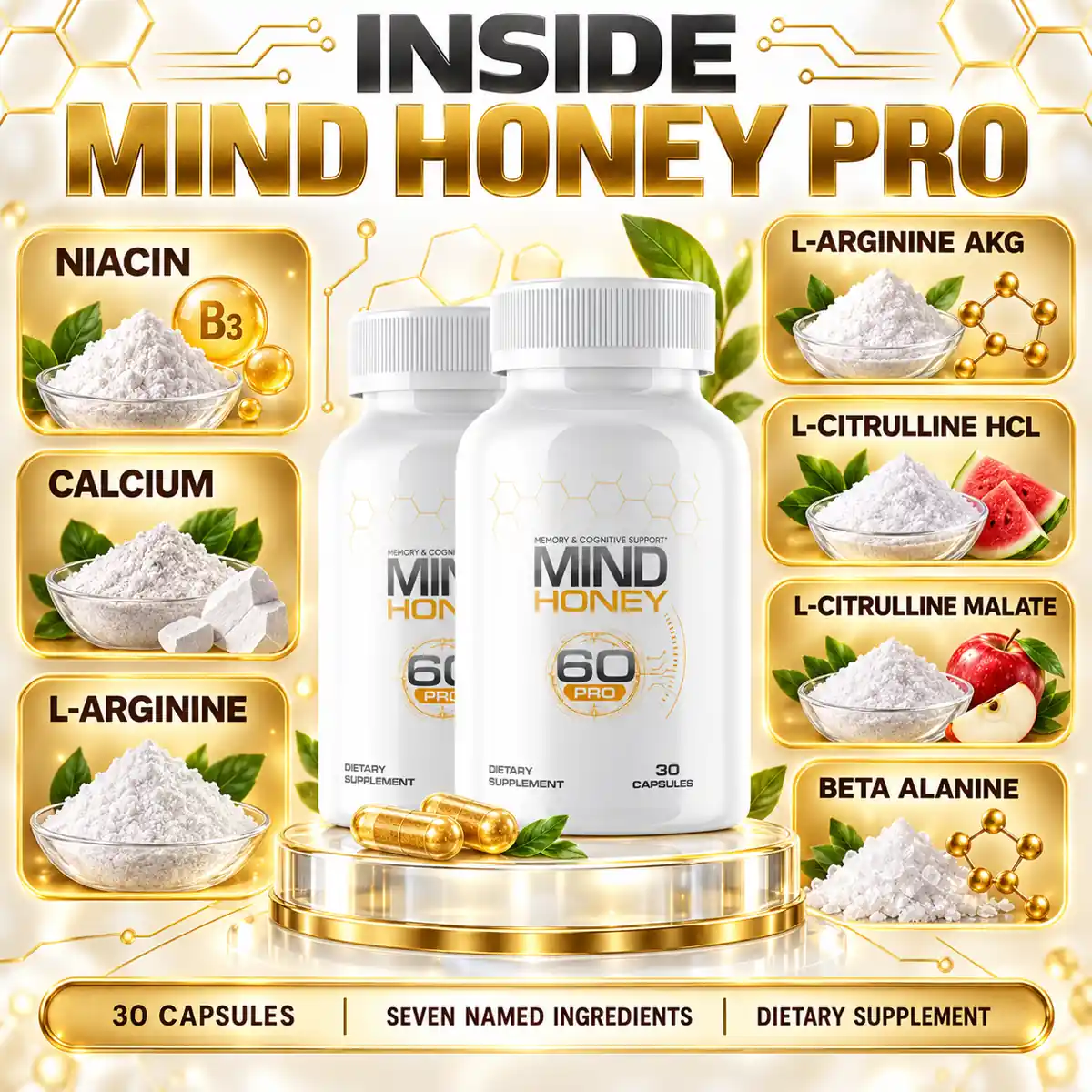
- Serving size is one capsule. Servings per container is 30. The label has no proprietary blend.
- Seven actives: niacin, calcium (as calcium carbonate), L-arginine, L-arginine AKG 2:1 extract, L-citrulline HCl, L-citrulline malate and beta alanine.
- The seven rows add up to 665.5 mg. Of that, 640 mg is the five amino acids.
- Only two rows carry a Daily Value: niacin at 47% and calcium at 1.5%. The other five are marked as not established.
- Other ingredients: hypromellose (vegetable capsule), vegetable stearate, silicon dioxide.
- The citrulline malate ratio is the one detail the panel does not print.
What is on the Mind Honey Pro ingredients list?
Start with the serving. One capsule is one serving, and a bottle holds 30. Everything below is per capsule.
| Row, as printed | Amount | % Daily Value |
|---|---|---|
| Niacin | 7.5 mg NE | 47% |
| Calcium (as Calcium Carbonate) | 18 mg | 1.5% |
| L-Arginine (base) | 200 mg | not established |
| L-Arginine AKG 2:1 Extract | 200 mg | not established |
| L-Citrulline HCl | 100 mg | not established |
| L-Citrulline Malate | 100 mg | not established |
| Beta Alanine | 40 mg | not established |
Add the weights and you get 665.5 mg. Subtract niacin and calcium (25.5 mg) and the five amino acids come to 640 mg.
The seven checks that follow take one row or pair at a time. Each sets the label amount beside the amount its own research used. That comparison is the most useful thing you can do with this formula.
Check 1: Does the niacin row mean something?
Yes. It is the strongest row on the panel. Niacin is vitamin B3, printed as 7.5 mg NE. An adult man needs 16 mg NE a day and an adult woman 14. So 7.5 divided by 16 is 46.9%, and the label prints 47%. The sum checks out.
The safe upper limit is 35 mg a day, and 7.5 mg NE is about a fifth of it. The skin flush people fear belongs to gram-scale nicotinic acid, not to this amount. The label does not say which form of niacin it uses. At 7.5 mg NE that makes no practical difference.
Check 2: Why is there only 18 mg of calcium?
Adults need 1,000 to 1,200 mg of calcium a day, so 18 mg is about a seventieth of a day. It is not a calcium supplement. Calcium carbonate is also a common flow agent in capsules, and at this weight that is the likelier reason it is there.
The label prints 1.5%. That figure fits a 1,200 mg reference. Against the current FDA reference of 1,300 mg it would print as about 1%. The capsule holds 18 mg whichever figure you use. Nothing on this website rests on the calcium row.
Check 3: What do the two arginine rows add up to?
On paper, 200 mg plus 200 mg is 400 mg. In truth it is less. The second row is arginine AKG in a 2:1 extract, so roughly two thirds of its weight is arginine. The honest total is nearer 330 mg.
Now the trial doses. The one randomised cognition trial on oral L-arginine gave 6.4 g a day for 30 days. Ten trials pooled in 2019 ran between 1.5 and 5 g a day. Both trials of arginine AKG used 12 g a day. The label is in milligrams. The research is in grams.
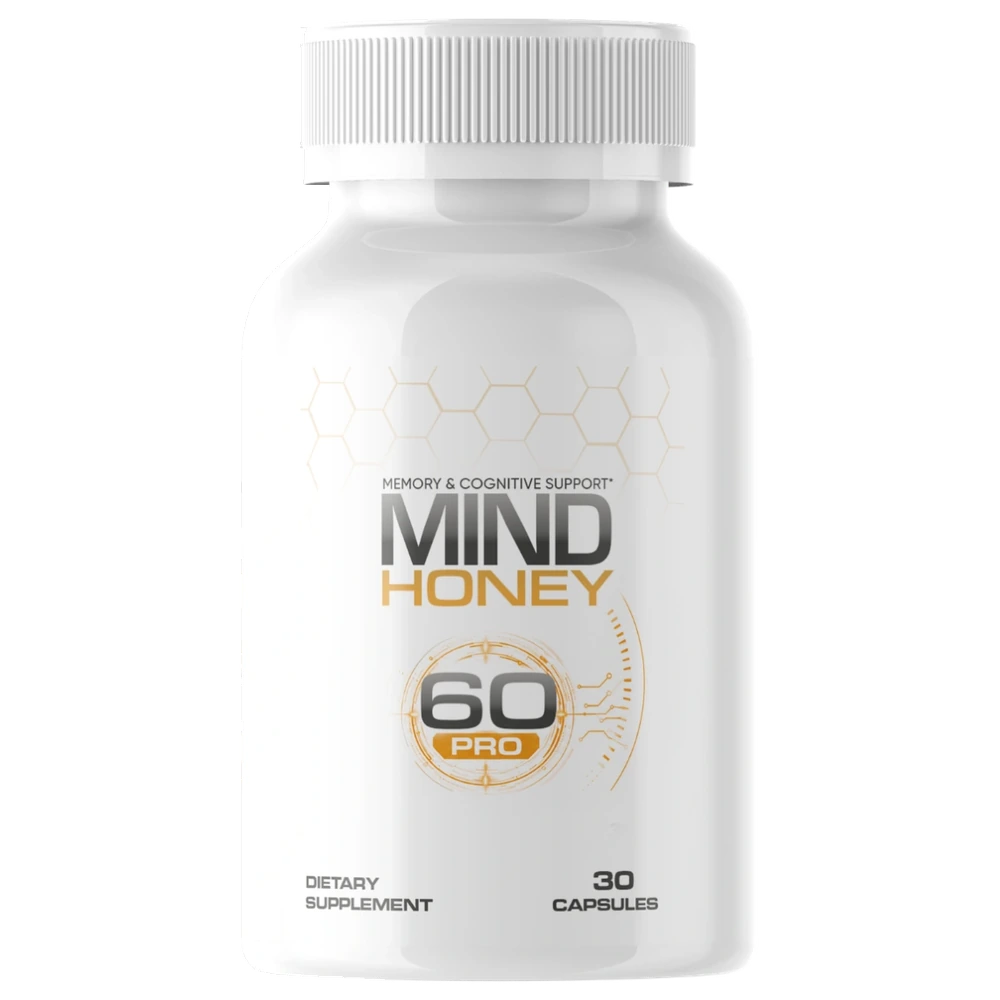
If you like a label where every row has a number, the seller’s page shows the live price for each pack and the written refund terms.
See today's price and guaranteeThe button opens the seller’s own checkout. Card details are entered there and never on this website. Disclosure: Themindhoneypro earns from orders placed through this checkout link.Check 4: What do the two citrulline rows add up to?
Two salts of one amino acid, 100 mg each. The hydrochloride and the malate each carry weight that is not citrulline, so the free citrulline is less than 200 mg.
The malate row cannot be worked out exactly. Citrulline malate is sold at 2:1 and at 1:1. At 2:1, 100 mg carries about 67 mg of citrulline. At 1:1 it carries about 50 mg. The panel prints neither ratio.
The smallest citrulline dose with a published human result was 1.5 g a day for a month. One hydrochloride row is a fifteenth of that, before the salt weight is taken off.
Check 5: How small is the beta alanine row?
It is the smallest active, at 40 mg. A ten-week imaging trial in 60-to-80-year-olds used 2.4 g a day, and only ten people (six supplemented, four control) were analysed. The sports nutrition position stand puts the working threshold at 4 to 6 g a day for four weeks.
Do the sum. 40 mg is 1% of 4 g, and less against 6 g. On the plus side, the tingling known as paresthesia is tied to single doses of about 800 mg and more. At 40 mg it is not expected.
Check 6: What else is inside the capsule?
- Hypromellose (vegetable capsule): the shell. It is a plant-based film, so the label reading suits a vegetarian diet.
- Vegetable stearate: a lubricant that keeps powder from sticking to the filling machines.
- Silicon dioxide: an anti-caking agent that keeps amino-acid powder from clumping.
A label statement is not a certification. The pack carries no vegetarian or vegan mark. If you need the certified version, ask the label company at [email protected]. The panel does not name gluten, dairy, soy or nuts, but that is an absence of a statement, not an allergen-free promise.
Check 7: What does the label leave out?
- The citrulline malate ratio, as above.
- The form of niacin.
- The amount of each inactive ingredient. That is normal, because inactives are listed by weight order only.
- The facility. The label adds the line Manufactured in the USA with globally sourced ingredients. That names a country, not a plant.
Set against a blend label, which hides all of this, these are small gaps. And there is a bigger one that has nothing to do with the panel: no trial of this seven-ingredient mix exists. The lot, MIN-26/TH-5324, and certificate reference, MIN-5324-26-TH, are filing references, not lab proof.
Frequently asked questions
What are the ingredients in Mind Honey Pro?
Seven actives: niacin, calcium (as calcium carbonate), L-arginine, L-arginine AKG 2:1 extract, L-citrulline HCl, L-citrulline malate and beta alanine. The other ingredients are hypromellose (vegetable capsule), vegetable stearate and silicon dioxide.
Is there a proprietary blend?
No. All seven actives have their own printed milligram amount. That is what makes each one checkable against a published trial.
How much real arginine is in a capsule?
Less than the 400 mg the two rows suggest. The base row is 200 mg of arginine. The AKG row is a 2:1 extract, so about two thirds of it is arginine. A fair reading is nearer 330 mg.
Why are there two citrulline rows?
They are two salts of the same amino acid, 100 mg each. The panel does not print the malate ratio, so the exact amount of citrulline cannot be worked out from the bottle.
Is the Mind Honey Pro formula vegetarian?
The shell is hypromellose, a vegetable capsule, and no animal material is named on the panel. That is the manufacturer’s label statement. The pack has no vegetarian certification mark.
Where can I see the full Supplement Facts panel?
On the bottle, and on the supplement facts page of this website, which transcribes it row by row. The picture above shows the unrolled label.
Sources named on this site
These are sources this website already cites for the topics above. We did not add others.
- Niacin, Dietary Reference Intakes chapter, Institute of Medicine. https://www.ncbi.nlm.nih.gov/books/NBK114304/
- Calcium requirement chapter, Institute of Medicine. https://www.ncbi.nlm.nih.gov/books/NBK56056/
- The one randomised cognition trial on oral L-arginine. https://pubmed.ncbi.nlm.nih.gov/42621366/
- The meta-analysis that sets the arginine dose range. https://pubmed.ncbi.nlm.nih.gov/30770070/
- The smallest citrulline dose with a published human result. https://pubmed.ncbi.nlm.nih.gov/21195829/
- The International Society of Sports Nutrition position stand. https://pubmed.ncbi.nlm.nih.gov/26175657/
Our view
This is a well-disclosed label with one useful row and five small ones. Niacin is at a real amount. The amino acids are in milligrams, below every dose their trials used. We say that plainly because the label lets us.
If you want niacin and a once-a-day capsule you can read, it fits. If you want the amino acids at their research doses, a single-ingredient powder would do more for the money, and the seller’s own pages say so.
Last updated
A full panel is easy to check. Check it, then decide
Every row on this label can be set beside its own research, which is the point of this article. When you are ready, look at the live price and the guarantee.
See today's price and guaranteePacks of 2, 3 or 6 bottles. One capsule a day, 30 per bottle. The checkout shows the current price. Disclosure: Themindhoneypro earns from orders placed through this checkout link.