Mind Honey Pro Official Website › Blog › Calcium At 18 mg
Calcium At 18 mg: The Row That Needs Stomach Acid It May Not Get
Calcium is the second row on this panel, printed at 18 mg and 1.5% of a Daily Value. That is not a dose worth arguing about on its own. What is worth a page is the chemistry underneath it: this particular calcium salt needs an acidic stomach to dissolve, and the label's own before-a-meal instruction is the one timing that chemistry does not prefer.
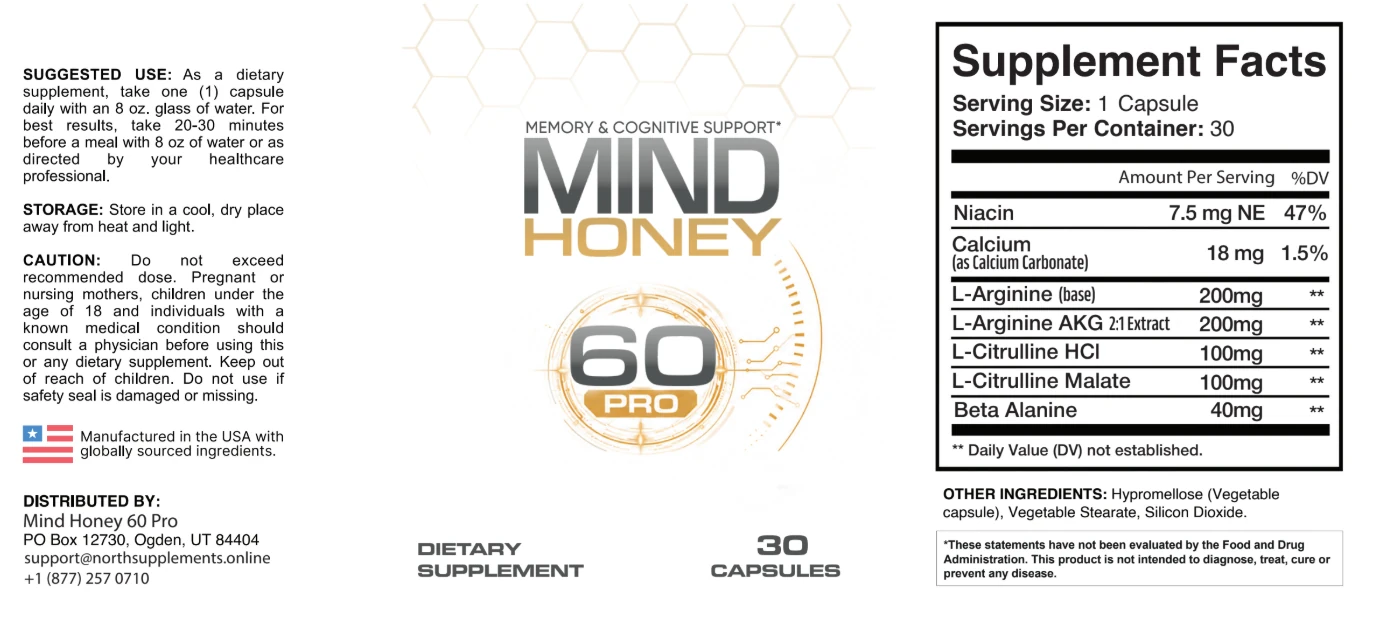
- Eighteen milligrams of calcium, as calcium carbonate, at 1.5% of the adult Daily Value.
- An adult's actual requirement runs roughly 1,000 to 1,200 mg a day by the Institute of Medicine's 2011 reference report, so this row supplies a fiftieth to a sixtieth of it.
- Calcium carbonate needs stomach acid to dissolve. That acid is reliably present with a meal, and less reliably present 20 to 30 minutes before one, which is what the label directs.
- At 18 mg, the chemistry is academic. Nothing about calcium status turns on a few milligrams either way.
- Two papers connect calcium, at doses well above this row, to worse outcomes in specific groups of older adults. Both are read in full below, at the dose each one actually used.
The row itself
Calcium (as Calcium Carbonate) sits directly under niacin on this panel, printed at 18 mg and 1.5%. The parenthetical matters more than it looks: calcium is sold in several chemical forms with different solubility profiles, and naming the form is what makes the rest of this page possible to write.
It is worth noting what this row is not. It is not in the Other Ingredients line with the hypromellose capsule shell, the vegetable stearate and the silicon dioxide. It is declared on the main panel with a Daily Value percentage, the correct treatment for an active nutrient, however small the amount.
What a full day of calcium actually looks like
The Institute of Medicine's 2011 reference report, still the document a calcium Daily Value is drawn from, sets adult intake goals in the neighbourhood of 1,000 mg a day for most adults and 1,200 mg a day for women over 50 and men over 70. Eighteen milligrams does not make a dent in either figure.
| Reference point | Roughly how far 18 mg falls short |
|---|---|
| 1,000 mg adult target | About a fifty-fifth of a full day |
| 1,200 mg target for women over 50 and men over 70 | About a sixty-seventh of a full day |
| A typical over-the-counter calcium tablet | An illustrative range rather than a cited figure: such tablets are commonly sold at several hundred milligrams each, well above this row |
The bottom row is stated as an illustrative range because no single source in this article measured this bottle against a specific competing tablet.
The chemistry: why this particular salt needs acid
Calcium carbonate is popular in supplements for a mundane reason: gram for gram, it carries more elemental calcium than most alternative salts, which is convenient when a formula is already sharing a capsule with six other actives. That convenience comes with a condition.
Calcium carbonate is poorly soluble in water. Before it can be absorbed, it has to dissolve into free calcium ions, and a review of hypochlorhydric stomach conditions is direct about what drives that step: stomach acid markedly increases the dissolution and ionisation of poorly soluble calcium salts, and where acid secretion is reduced, the dissolution and the absorption that depends on it both suffer.
An older review, still widely cited on this exact question, narrows things further. The absorption penalty from low stomach acid shows up specifically when a poorly soluble calcium salt is taken after an overnight fast — on an empty stomach. Taken with a meal, the same review found calcium carbonate absorbed normally even in people with reduced acid output from atrophic gastritis.
Where the label's own timing clashes with that chemistry
The suggested use on this bottle is one capsule daily with an 8 oz glass of water, 20 to 30 minutes before a meal. That instruction is almost certainly written for the amino acid rows. Arginine and citrulline absorb better away from competing dietary protein, and a formula built on four amino-acid rows out of seven has an obvious reason to default to a before-meal schedule.
Read purely as calcium chemistry, twenty to thirty minutes before eating is still an empty stomach — the one window the gastric-acidity review above ties to weaker calcium carbonate absorption. Taking the same capsule alongside food, rather than ahead of it, sits inside the more favourable window that review and the hypochlorhydria review both describe. It is a genuine, small tension between what helps one row and what helps another, on the same label.
Why the clash does not actually matter at 18 mg
Naming a tension is not the same as recommending a change. At 18 mg, even a pessimistic reduction in absorption efficiency from empty-stomach timing moves the actual calcium delivered by a few milligrams at most, against a body that already handles calcium intake from ordinary food in the hundreds of milligrams a day. Nobody's calcium status, bone health or blood level turns on a difference that size.
Follow the label as printed. This section exists to show the chemistry honestly, not to suggest a different routine for a formulation-scale row that was never trying to be a calcium supplement in the first place.
Order Mind Honey Pro knowing what this row is and is not
Seven actives with every milligram printed, including the 18 mg calcium row this article is about, one capsule a day and 180 days from purchase to reach your own view.
Two bottles $158 · six bottles $294 · 180-day money-back guarantee
Order Mind Honey Pro On The Official WebsiteOne capsule a day · 30 per bottle · lot MIN-26/TH-5324
A Gothenburg study, and the dose it left unpublished
Nothing on this label claims that calcium supports memory. The claim on the bottle rests on the formula as a whole, and calcium's own relationship to cognition is a separate, genuinely mixed literature that deserves to be read on its own terms rather than bent to fit the product.
A five-year, population-based study from Gothenburg, Sweden followed 700 dementia-free women aged 70 to 92, ninety-eight of whom were taking a calcium supplement. Supplement users had roughly double the odds of developing dementia over follow-up, and more than six times the odds of stroke-related dementia if they already had a history of stroke. Women with no stroke history or white matter lesions on imaging showed no significant association.
| Group | Finding | Confidence |
|---|---|---|
| All 700 women | Roughly double the odds of dementia among supplement users | OR 2.10, 95% CI 1.01–4.37 |
| Stroke-related dementia, whole group | More than four times the odds | OR 4.40, 95% CI 1.54–12.61 |
| Women with a prior stroke | Nearly seven times the odds | OR 6.77, 95% CI 1.36–33.75 |
| No stroke history or white-matter lesions | No significant association | Not significant |
What the paper does not print is the milligram strength each of its 98 supplement users actually took; it records use, not dose. As an explicitly illustrative range rather than a figure this paper reports, stand-alone calcium supplements are conventionally sold in the hundreds of milligrams, which would put a typical user tens of times above this bottle's 18 mg row. The study's own authors call their sample relatively small, their design observational, and ask for the finding to be confirmed before it is treated as settled.
Read honestly, that is a conversation for a doctor and a dedicated calcium supplement in a woman with a stroke history — not a reason to be wary of a formulation-scale row on an unrelated capsule.
A second study, measuring something different entirely
A separate study, using the Alzheimer's Disease Neuroimaging Initiative cohort of 1,224 older adults without dementia at baseline, measured serum calcium — the concentration circulating in blood, not anything anyone swallowed as a pill. Higher serum calcium tracked with faster cognitive decline and a higher rate of conversion to Alzheimer's dementia, and correlated with several imaging and cerebrospinal fluid markers of disease severity.
This is a different kind of evidence from the Gothenburg study, and worth keeping separate. Serum calcium sits inside one of the body's most tightly regulated systems — parathyroid hormone, vitamin D and the kidneys hold it in a narrow range largely independent of day-to-day intake. An 18 mg contribution from a single capsule, layered onto an ordinary diet already supplying several hundred milligrams, is not a plausible lever on that number. The study's own authors ask for more mechanistic research rather than pointing at diet or supplements, and this article follows that lead.
The cardiovascular question this row does not raise
It would be tempting to read the two papers above and conclude that a bigger calcium row would be the safer choice. A review of cardiovascular complications tied to calcium supplements is the reason that conclusion does not hold up. It summarises meta-analytic work associating calcium supplements, with or without vitamin D, with an increased risk of myocardial infarction in several independent re-analyses, some individually underpowered but consistent in direction.
Put the three papers together and the honest reading is not that more calcium is safer, or that less is. It is that calcium taken as a dedicated supplement, at doses in the hundreds of milligrams, is a nutrient with real effects in more than one direction, and the right amount for any one person depends on diet, bone health and cardiovascular history far more than on anything a blog post can generalise. At 18 mg, this bottle is not attempting to be that supplement, in either direction.
Reading this row the way it deserves
- It carries a Daily Value percentage, which separates it from the amino acid rows and tells you it is a nutrient, not a proprietary blend component.
- At 1.5% of a day's calcium, it is a formulation-scale amount, not a supplement-scale one.
- Its chemical form has a real absorption requirement — stomach acid, ideally with food — that the label's own before-meal instruction does not favour, though the effect at this dose is too small to matter in practice.
- The dementia and serum-calcium literature above is real and worth knowing, and neither study examined anything close to this dose.
- Reading an 18 mg row as either a bone-health bonus or a cardiovascular risk asks it to be something the panel never printed it as.
The supplement facts page shows this row beside the other six, and the article on the niacin row is where this one was first mentioned, briefly, before this page took it further.
References
- Ross AC, Manson JE, Abrams SA, et al. The 2011 report on dietary reference intakes for calcium and vitamin D from the Institute of Medicine: what clinicians need to know. J Clin Endocrinol Metab. 2011;96(1):53-58. PMID 21118827. https://pubmed.ncbi.nlm.nih.gov/21118827/
- Wood RJ, Serfaty-Lacrosniere C. Gastric acidity, atrophic gastritis, and calcium absorption. Nutr Rev. 1992;50(2):33-40. PMID 1570081. https://pubmed.ncbi.nlm.nih.gov/1570081/
- Sipponen P, Härkönen M. Hypochlorhydric stomach: a risk condition for calcium malabsorption and osteoporosis? Scand J Gastroenterol. 2010;45(2):133-138. PMID 19958055. https://pubmed.ncbi.nlm.nih.gov/19958055/
- Kern J, Kern S, Blennow K, et al. Calcium supplementation and risk of dementia in women with cerebrovascular disease. Neurology. 2016;87(16):1674-1680. PMID 27534711. https://pubmed.ncbi.nlm.nih.gov/27534711/
- Ma LZ, Wang ZX, Wang ZT, et al. Serum Calcium Predicts Cognitive Decline and Clinical Progression of Alzheimer's Disease. Neurotox Res. 2021;39(3):609-617. PMID 33216282. https://pubmed.ncbi.nlm.nih.gov/33216282/
- Reid IR, Bristow SM, Bolland MJ. Cardiovascular complications of calcium supplements. J Cell Biochem. 2015;116(4):494-501. PMID 25491763. https://pubmed.ncbi.nlm.nih.gov/25491763/