Mind Honey Pro Official Website › Blog › How Nitric Oxide Is Supposed To Reach Memory
How Nitric Oxide Is Supposed To Reach Memory
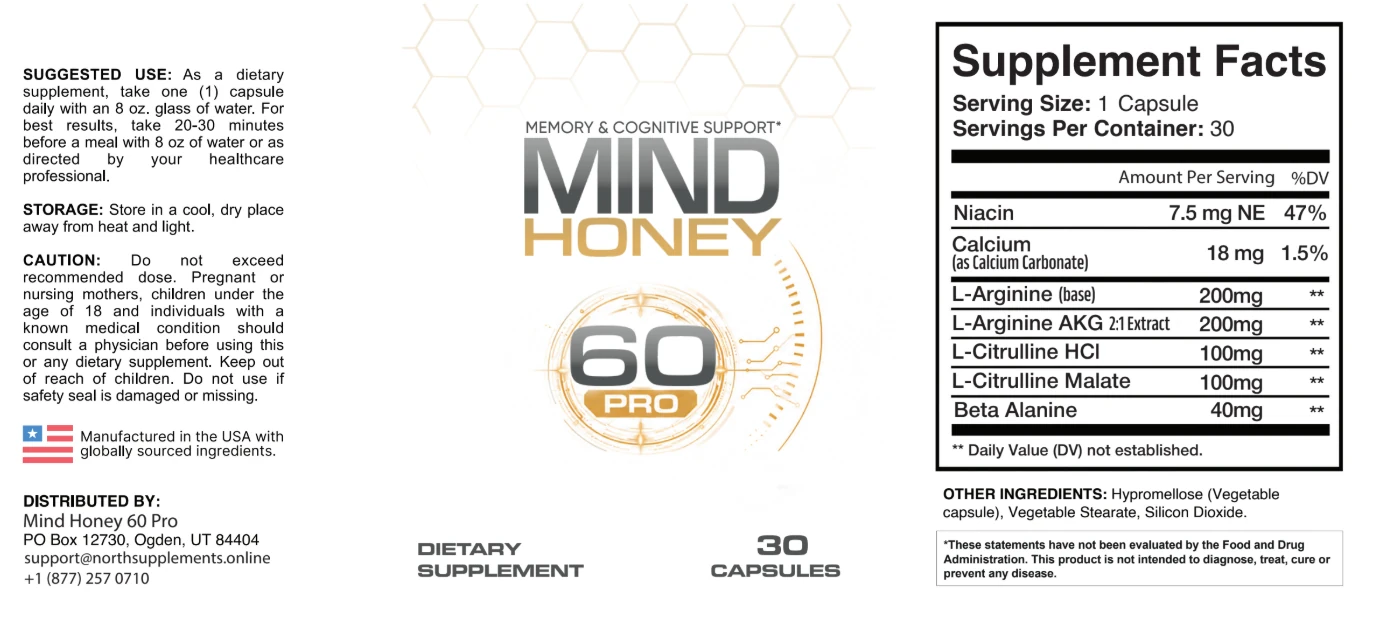
Four of the seven rows on this panel exist to feed one enzyme system: nitric oxide synthase. The milligram arithmetic for those rows is covered elsewhere on this site. This article asks the question underneath the arithmetic — what is nitric oxide actually meant to do for memory — and follows it to the one trial that tested a nitric-oxide-raising intervention against cognition directly, and found nothing.
- Arginine and citrulline both feed nitric oxide synthase, the enzyme that makes nitric oxide in blood vessel walls and, separately, inside neurons.
- The vascular story is old and well established: nitric oxide relaxes vessels, including the small vessels that supply the brain.
- A newer literature describes nitric oxide acting directly at synapses, in the signalling thought to underlie memory consolidation.
- The most direct human test of raising nitric oxide and measuring cognition and cerebral blood flow together, using dietary nitrate, found no change in older adults over 13 weeks.
- A different, patented arginine compound has shown a positive acute cognitive result, which keeps the idea alive without rescuing this specific formula's own evidence.
What the four rows are feeding
L-Arginine (base), L-Arginine AKG 2:1 Extract, L-Citrulline HCl and L-Citrulline Malate are four rows for one idea. Arginine is the direct substrate nitric oxide synthase converts into nitric oxide, releasing citrulline as a byproduct; citrulline, taken on its own, is recycled back into arginine by the kidneys. Whichever form or combination reaches the bloodstream, it is headed for the same enzyme.
Nitric oxide itself does not sit in storage. It is a gas, made on demand, active for seconds before it degrades. Every mechanism in this article assumes a steady supply of substrate reaching the enzyme, which is the whole rationale for printing four separate arginine and citrulline rows rather than one.
The milligram-by-milligram case for why arginine and citrulline are split into paired forms belongs to a separate article on this site. This one stays on a single question: assuming the enzyme gets its substrate, what is the nitric oxide actually supposed to buy a reader's memory.
The old half of the story: relaxing vessels
The clearest part of this mechanism is vascular, and it has been textbook physiology for decades. Nitric oxide made in the endothelium — the single-cell lining of a blood vessel — diffuses into the surrounding smooth muscle and relaxes it. A relaxed vessel is a wider vessel, and a wider vessel moves more blood for the same pressure.
Applied to the brain, the argument is that better perfusion through small cerebral vessels supports the oxygen and glucose demands of active neural tissue. A 2023 review published in Stroke lays this out specifically for cognitive health, describing endothelial nitric oxide as playing a role in preserving cerebral blood flow regulation over time. It is careful to frame this as a preservation story — helping prevent decline — rather than an enhancement story for someone whose vessels already work normally.
Why an aging system is the whole marketing premise
The reason this category of ingredient is marketed to an older audience specifically is that endothelial nitric oxide production is well documented to decline with age. Vessels stiffen, the synthase enzyme becomes less efficient, and molecules that compete with or inhibit nitric oxide signalling accumulate over decades.
That decline is genuine, and it is the honest reason arginine and citrulline appear on a cognition label at all. It is a separate question from whether a fixed milligram row, on any label, restores what age has taken away. The size of the age-related deficit and the size of the row meant to offset it are not the same number, and only one of them is printed on this bottle.
The newer half: nitric oxide at the synapse
The vascular mechanism is not the whole picture, and stopping there undersells how the science has actually moved. A distinct form of the synthase enzyme operates inside neurons themselves, where nitric oxide behaves as a signalling molecule rather than a vessel relaxant.
A 2025 review of nitric oxide's molecular role in memory consolidation works through this in detail: nitric oxide participates in the synaptic changes believed to convert a short-term experience into a lasting memory, and the same review links disrupted signalling here to the pathogenesis of memory-related disorders.
| Mechanism | Where | Proposed role | Evidence type |
|---|---|---|---|
| Vascular | Smooth muscle around cerebral vessels | Relax vessels, support blood flow and delivery | Established physiology; reviewed for cognitive relevance |
| Neuronal | Synapses | Signalling in memory consolidation | Newer, mechanistic, fewer outcome trials |
Two real, independent mechanisms. Neither is a trial of this capsule.

Order Mind Honey Pro knowing what the pathway can and cannot claim
Four rows feed the mechanism this article describes, each printed rather than blended away. One capsule a day and 180 days from purchase to reach your own view.
Two bottles $158 · six bottles $294 · 180-day money-back guarantee
Order Mind Honey Pro On The Official WebsiteOne capsule a day · 30 per bottle · lot MIN-26/TH-5324
The trial that tested the idea directly
A page that stops at mechanism and never asks what happened when someone tested it is telling half the story. The most direct human test of raising nitric oxide and watching cognition and cerebral blood flow together did not use arginine or citrulline at all. It used dietary nitrate, a different and longer-studied route to the same molecule, delivered as beetroot juice.
A 13-week pilot randomised controlled trial gave overweight and obese older adults incremental doses of nitrate-rich beetroot juice and measured cognitive function and cerebral blood flow directly, with imaging. Its own title states the result: the intervention did not modify either outcome.
That negative finding deserves to sit beside the mechanism sections above rather than be left out of them. Nitrate reaches nitric oxide by a route that bypasses nitric oxide synthase entirely — a nitrate-nitrite-nitric-oxide pathway — so the trial is not a direct test of the enzyme this label's four rows feed. It is, all the same, the strongest available human evidence that raising nitric oxide through an established route does not automatically translate into a measurable cognitive or blood-flow change in older adults, and any honest account of this pathway has to carry that caution.
A different form, a positive result, an important distinction
Not every finding here is negative. A 2021 trial tested a patented, inositol-stabilised arginine silicate compound and reported improved cognitive outcomes in healthy adults after a single acute dose.
Two things follow from that result. First, a genuine positive human signal exists somewhere in the arginine family, so the whole idea is not purely theoretical. Second, the compound tested was chemically distinct from the L-arginine base and the AKG-bound arginine on this panel, studied at its own dose in its own trial. No published study has tested those two specific forms, at this bottle's printed amounts, against a cognitive outcome the way this trial tested its own preparation.
What chronic dosing looks like in a treated population
A study of chronic oral L-arginine administration in patients with peripheral arterial or coronary artery disease is useful for a different reason: it tested ongoing, everyday arginine dosing against the pathway directly, rather than a single dose, and reported that sustained oral arginine prevented renal loss of nitrite, the body's major reservoir of nitric oxide-related compounds, over the treatment period.
That is a vascular-disease population treated for a vascular outcome, not a cognitively healthy population screened for memory. It supports the underlying biochemistry — sustained oral arginine can move the nitric oxide reservoir over time — without lending its result to a different population's cognitive claim.
It is also a reminder of something easy to lose in a page built mostly from review articles and a single negative trial: the arginine and nitric oxide pathway is one of the better-studied areas of human nutrition science, just not for this specific outcome. Decades of cardiovascular and vascular-disease research established the dose ranges, the safety profile and the basic pharmacokinetics long before anyone asked whether the same pathway might matter for memory. That history is why a plausible mechanism exists to write about at all, and it is also why the absence of a matching cognitive trial stands out rather than being unremarkable. A well-mapped pathway with an untested final step is a different, more specific situation than an untested ingredient with no pathway behind it at all.
The chain, and exactly where it stops being proven
Laid end to end, four links hold this pathway together: the amino acid reaches the enzyme, the enzyme makes nitric oxide, the nitric oxide acts on vessels and neurons, and that action adds up to a person noticing their own memory work differently. The first two links are basic biochemistry. The third has real support from both the vascular and neuronal literature above.
The fourth link is the one nothing in this article closes: that this specific formula, at these specific amounts, produces a noticeable change in a person taking it. The beetroot trial shows that even a well-studied, different route to more nitric oxide did not close that link under controlled conditions. That is the honest state of the whole ingredient category, not a defect unique to one brand.
What this page is and is not saying
This is not an argument that arginine and citrulline do nothing, or that the mechanism is invented. The biochemistry is real, a major stroke journal has reviewed the vascular and neuronal roles of nitric oxide in cognitive health seriously, and a chemically distinct arginine compound has a positive human trial behind it.
What it is arguing is narrower: a plausible pathway is not the same thing as a proven outcome, and the one trial that tested a nitric-oxide-raising intervention against cognition and cerebral blood flow together, in an older population, found nothing. The article on this site's beta-alanine trial makes a parallel point about sample size; this one makes it about mechanism. Read the pathway with genuine interest, and read the outcome data as its own, separate question.
References
- Katusic ZS, d'Uscio LV, He T. Emerging Roles of Endothelial Nitric Oxide in Preservation of Cognitive Health. Stroke. 2023;54(3):686-696. PMID 36848426. https://pubmed.ncbi.nlm.nih.gov/36848426/
- Bahdar ZI, Abu-El-Rub E, Almazari R, et al. The molecular mechanism of nitric oxide in memory consolidation and its role in the pathogenesis of memory-related disorders. Neurogenetics. 2025;26(1):24. PMID 39853459. https://pubmed.ncbi.nlm.nih.gov/39853459/
- Babateen AM, Shannon OM, O'Brien GM, et al. Incremental Doses of Nitrate-Rich Beetroot Juice Do Not Modify Cognitive Function and Cerebral Blood Flow in Overweight and Obese Older Adults: A 13-Week Pilot Randomised Clinical Trial. Nutrients. 2022;14(5):1042. PMID 35268027. https://pubmed.ncbi.nlm.nih.gov/35268027/
- Gills JL, Campitelli A, Jones M, et al. Acute Inositol-Stabilized Arginine Silicate Improves Cognitive Outcomes in Healthy Adults. Nutrients. 2021;13(12):4272. PMID 34959823. https://pubmed.ncbi.nlm.nih.gov/34959823/
- Schneider JY, Rothmann S, Schröder F, et al. Effects of chronic oral L-arginine administration on the L-arginine/NO pathway in patients with peripheral arterial occlusive disease or coronary artery disease: L-Arginine prevents renal loss of nitrite, the major NO reservoir. Amino Acids. 2015;47(9):1961-1974. PMID 26123989. https://pubmed.ncbi.nlm.nih.gov/26123989/