Mind Honey Pro Official Website › Blog › Sleep And Memory
Sleep And Memory: The Variable That Can Swamp A Capsule Trial
Anyone who starts a memory capsule and judges it two months later is running a small experiment on themselves. The experiment has a large uncontrolled variable running through it every single night. Sleep sets how much of the day you keep, it changes from week to week without announcing itself, and it can produce an improvement or hide one. Here is what the research says about it, and what to write down so that it does not decide the verdict for you.
- In the reviews summarised below, sleep is described as benefiting memory retention, with slow-wave sleep central to consolidation. One night without it also weakened the brain’s ability to encode new memories.
- A meta-analysis of 70 studies found effects of short-term total sleep deprivation ranging from small and non-significant to large, with the largest on lapses of attention.
- In adults aged 55 and over, self-reported short sleep and long sleep were both associated with poorer cognition, with odds ratios of 1.40 and 1.58.
- For healthy adults the National Sleep Foundation panel recommended 7 to 9 hours, and 7 to 8 hours for older adults.
- Sleep disturbances predict later dementia in cohort studies, but mostly by self-report, and association is not proof.
- The capsule’s label makes no claim about sleep. The point is that a test of it should record sleep, because sleep can outweigh whatever the capsule does.
The variable nobody puts on the label
A memory capsule sells itself against a background that is never mentioned on the bottle. You sleep, or you do not, every night of the test. Nothing else in the routine comes close to it for size.
This is the same problem that the article on memory changes worth getting checked raises about causes, seen from the other side. That article lists short or broken sleep among seven ordinary causes of a memory complaint. This one asks what the research says about how large the effect is, and what a person running their own eight-week trial should do about it.
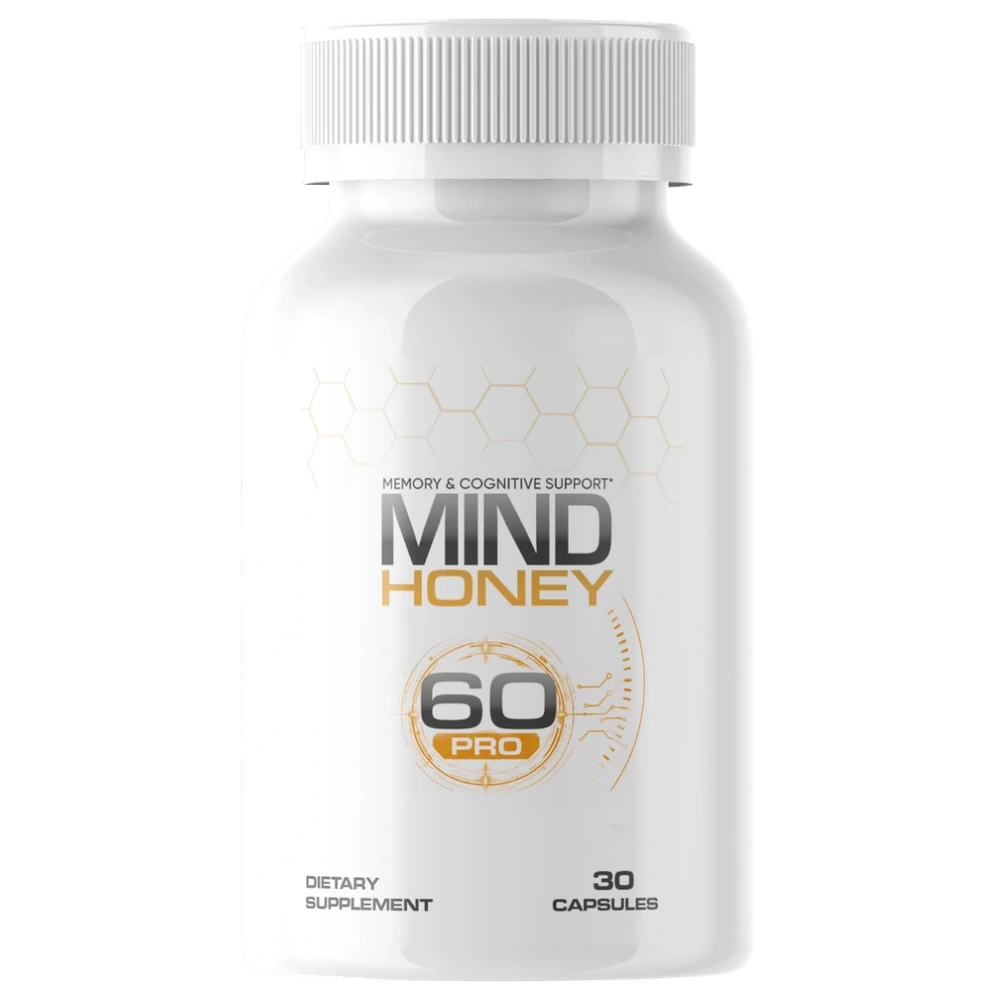
Mind Honey Pro is a capsule with seven printed rows and one capsule a day. Nothing on the label makes a claim about sleep, and this article makes none for it. Sleep is here as a confounder, in the statistical sense, and as one of the few things a reader can measure and change without spending anything.
What sleep is doing for memory
The most comprehensive single source is a 2013 review in Physiological Reviews that covers the field from its historical theories to the newer findings. It describes an old picture, in which sleep passively protects memories from interference, giving way to an active one. On the current view, memories are consolidated during sleep, being reactivated and redistributed from a temporary store into long-term storage.
The review sets out three points that are useful to a lay reader.
- Older work concentrated on rapid-eye-movement sleep. Recent work has shown the importance of slow-wave sleep for consolidation.
- The two states are described as suited to different jobs: the waking brain is optimised for encoding memories, and sleep is a brain state optimising their consolidation.
- Reactivation of recently encoded representations occurs in slow-wave sleep, and the ensuing REM sleep may stabilise the transformed memories.
In everyday terms, learning happens when you are awake, and keeping happens largely when you are not.
Sleep before learning, too
It is natural to assume that sleep only matters after you have learned something. A study published in Nature Neuroscience in 2007 tested the other side. It found that a single night of sleep deprivation produced a significant deficit in hippocampal activity during episodic memory encoding, and worse subsequent retention. The authors concluded that an absence of prior sleep substantially compromises the neural and behavioural capacity for committing new experiences to memory.
That matters for a home test. A poor night does not only threaten what you learned yesterday. It affects what you can take in today.
How big is the effect of a bad night?
Effect sizes are hard to feel, so here is one summary of how far the research spreads. A 2010 meta-analysis in Psychological Bulletin pooled 70 articles containing 147 cognitive tests on the effects of short-term total sleep deprivation, defined as under 48 hours. It sorted the tests into six categories: simple attention, complex attention, working memory, processing speed, short-term memory and reasoning.
Effect sizes ranged from small and non-significant, for the accuracy of reasoning at g = −0.125, to large, for lapses in simple attention at g = −0.776. Effects differed significantly across the domains for both speed and accuracy. Of the moderators tested, only time awake predicted how much the studies varied, and only for accuracy.
Two cautions keep that from being over-read. First, the studies were of total deprivation for under two days, which is more severe than the ordinary poor nights most people have. Second, the biggest effect was on attention lapses rather than memory as such. The point for a home test is not that one bad night erases memory. It is that the tests people run on themselves, such as recalling a name or holding a thread, depend heavily on attention, and attention is what a bad night hits first.
Too little, and also too much
It is a common assumption that more sleep is always better for the brain. The literature is less tidy. A 2016 meta-analysis looked at self-reported sleep duration and cognition in adults aged 55 and over. It pooled 35 independent samples with 97,264 people from 11 cross-sectional and 7 prospective cohort studies. Compared with normal sleepers, short sleepers had 1.40 times the odds of poor cognitive function (interval 1.27 to 1.56) and long sleepers had 1.58 times the odds (interval 1.43 to 1.74).
The authors called extreme sleep duration a risk factor for cognitive ageing. This desk would put it more modestly: the association runs in both directions from the middle, it is based on self-reports, and it cannot tell you whether the sleep pattern is a cause or an early sign. Someone whose thinking is already changing may start sleeping differently.
| Measure | Figure | Source |
|---|---|---|
| Recommended sleep, healthy adults | 7 to 9 hours | National Sleep Foundation expert panel. |
| Recommended sleep, older adults | 7 to 8 hours | Same panel. |
| Odds of poor cognition, short sleepers aged 55+ | 1.40 (1.27 to 1.56) | The 2016 meta-analysis. |
| Odds of poor cognition, long sleepers aged 55+ | 1.58 (1.43 to 1.74) | Same analysis. |
| Adults with short sleep, under 6 hours | 6.5% | The lifespan meta-analysis below. |
| Adults with poor sleep quality | 13.3% | Same analysis. |
| Adults with insomnia symptoms | 9.6% to 19.4% | Same analysis. |
The recommended ranges come from the National Sleep Foundation’s duration update, for healthy people with normal sleep. The prevalence figures come from a meta-analysis of 1.1 million people in the Netherlands, the United Kingdom and the United States.
The last three rows carry a useful surprise. In that lifespan analysis, poor sleep quality and insomnia symptoms were more common in adults than short sleep duration was. In other words, plenty of people who are in bed long enough are still not sleeping well. Insomnia symptoms were also 1.5 to 2.9 times as frequent in the United States as in the other two countries. A duration alone is a weak measure.
Order Mind Honey Pro and keep the sleep column
One capsule a day, thirty to a bottle, and 180 days from the date of purchase to change your mind. Sleep can move your memory more than a label can, so this desk would rather you measure it than take our word for anything.
Two bottles $158 · six bottles $294 · 180-day money-back guarantee
Order Mind Honey Pro On The Official WebsiteOne capsule a day · 30 per bottle · lot MIN-26/TH-5324
What the dementia-risk literature says, and does not
Sleep and dementia risk is a well-known topic and one that is easy to over-read. A 2018 systematic review and meta-analysis pooled 18 longitudinal studies with 246,786 people at baseline and 25,847 cases of dementia after an average of 9.49 years. People who reported sleep disturbances had a higher risk of incident dementia, Alzheimer’s disease and vascular dementia. By subtype, insomnia was associated with Alzheimer’s disease but not with vascular or all-cause dementia, while sleep-disordered breathing was associated with all three.
The authors add the caveats themselves: the sleep problems were mostly assessed by self-report, and some confounders may mediate the relationship. That is an important limit, and it is the same one that applies to capsule reviews: what people report about themselves is useful and it is not a measurement.
Two practical readings follow, without pretending to more than the paper shows. First, sleep-disordered breathing, which includes sleep apnoea, is a treatable problem that shows up in these results, and a partner who notices loud snoring or pauses in breathing is giving useful information to a doctor. Second, none of this says a memory capsule can affect any of it, and a bottle should never be the answer to a night of poor breathing.
Why this matters for a two-month test at home
The how-to-use page suggests counting three concrete memory events for a week before you start, and again at the end of the second bottle. It is a good design. It has one gap, which is that both counting weeks could be very different in sleep, and a difference in sleep can produce a difference in the counts that has nothing to do with a capsule.
Consider four scenarios.
- Sleep improves and memory improves. Did the capsule help, or did the nights? You cannot tell without the sleep record.
- Sleep worsens and memory is flat. A flat result against worse sleep might hide a small benefit, or it might not.
- Sleep is stable and memory improves. That is the only scenario in which a reading is fairly clean, and even then the counts are subjective.
- Sleep varies wildly. Neither week means much, and the honest answer is to extend the test or repeat it.
None of this is a criticism of the routine. It is the reason for keeping a test long and honest: the longer it runs, the more the ordinary variation in your life gets a vote. The results timeline sets out how long the trials behind these ingredients ran. The article on remembering to take it covers the other half of a fair test, which is actually taking the capsule for those eight weeks.
Self-reported sleep is imperfect too
Before you lean on a sleep diary, know its limit. The same lifespan analysis notes that women aged 41 and over reported sleeping shorter times, or slightly less efficiently, than men did, whereas activity-monitor estimates put them as sleeping longer and more efficiently than men. Self-report and measurement can disagree, in either direction. It also found that one in four people slept less than the recommendation for their age, but only 5.8% slept outside what the authors call the acceptable range, so most people who fall short fall short by a little.
The lesson is a modest one. A diary is a rough tool. Its value is in comparing your own weeks with each other, not in producing a number to set beside a textbook.
A worked example, with invented numbers
The figures in this paragraph are made up, to show the logic and nothing more. Suppose a reader counts names forgotten in conversation over one week and gets 10. Eight weeks later the count is 6. In the first week the reader averaged about 6 hours of sleep, and in the eighth about 7 and a half. The count fell by four, and the sleep rose by an hour and a half, and on that record nobody, the reader included, can say which change produced which.
Now suppose a second reader gets the same 10 and 6 but sleeps about 7 hours in both weeks. That result is cleaner. It is still unblinded and still subjective, and no comparison group exists, but at least the most obvious rival explanation was held roughly still. Neither example is data. What the sleep column buys you is not an answer. It is the ability to tell honestly when you do not have one.
A sleep column for the diary
Add two lines to whatever you already keep. Neither takes more than ten seconds.
- Time you went to bed and time you got up. Write it in the morning, from your best guess. It is imprecise and it is far better than nothing.
- One word for how the night went. Good, broken, short, or long. The lifespan analysis shows that quality complaints are commoner than duration ones, so a duration figure alone would miss most of what matters.
At eight weeks, look at the two columns together. If the memory marks and the sleep marks moved together, the capsule is not the obvious explanation. If the memory marks moved and the sleep marks did not, you have something worth taking to a fair conversation with yourself.
What has evidence for fixing sleep
This is a supplement website, not a sleep clinic, so the guidance stays short and sourced.
The 2023 European insomnia guideline recommends cognitive-behavioural therapy for insomnia as the first-line treatment for chronic insomnia in adults of any age, delivered in person or digitally. It reserves medicines for cases where that is not sufficient, and generally for short-term use. That is a strong statement from a guideline panel, and it is the answer to the question a chronic poor sleeper should ask a clinician: what is the non-drug option?
Naps are a different question. A 2021 meta-analysis of daytime naps covered 11 studies, almost all in laboratories, with 381 working-age participants. Overall cognitive performance improved after a nap, by an effect size of 0.18, and alertness more so, by 0.29. Early-afternoon naps, before 1 p.m., did better. It says little about older adults, and it measured performance on the day rather than memory over weeks, so this desk offers it as a modest note and not as a recommendation.
If you take one thing from this section, it is the order of operations that the checked-memory article also stresses. Sleep problems worth treating should be looked at directly, and a capsule taken meanwhile cannot tell you which one helped.
The line this article will not cross
It would be easy to write a piece that begins with sleep and ends with a bottle. This one does not, and the reason is that no paper cited here tested a seven-ingredient capsule against sleep, or against anything else.
What the research does show is that sleep is a large and changeable influence on the thing a memory capsule is bought to improve. That is a reason to keep a sleep record beside the memory record, and a reason to be humble about a two-month verdict. It is not a reason to buy or not to buy. The 180-day window and the diary are the parts of the purchase you can actually control, and the article on the count on the bottle explains why a bottle is thirty days.
Mind Honey Pro is a dietary supplement for healthy adults of eighteen and over, not a drug, and it is not FDA-approved. It is not intended to diagnose, treat, cure or prevent any disease, sleep disorders and dementia included, and it makes no claim about sleep. Persistent poor sleep, loud snoring, pauses in breathing or a change in memory are reasons to see a clinician, and nothing above replaces an assessment.
References
- Rasch B, Born J. About sleep's role in memory. Physiol Rev. 2013;93(2):681-766. PMID 23589831. https://pubmed.ncbi.nlm.nih.gov/23589831/
- Yoo SS, Hu PT, Gujar N, et al. A deficit in the ability to form new human memories without sleep. Nat Neurosci. 2007;10(3):385-92. PMID 17293859. https://pubmed.ncbi.nlm.nih.gov/17293859/
- Lim J, Dinges DF. A meta-analysis of the impact of short-term sleep deprivation on cognitive variables. Psychol Bull. 2010;136(3):375-89. PMID 20438143. https://pubmed.ncbi.nlm.nih.gov/20438143/
- Lo JC, Groeger JA, Cheng GH, et al. Self-reported sleep duration and cognitive performance in older adults: a systematic review and meta-analysis. Sleep Med. 2016;17:87-98. PMID 26847980. https://pubmed.ncbi.nlm.nih.gov/26847980/
- Hirshkowitz M, Whiton K, Albert SM, et al. National Sleep Foundation's sleep time duration recommendations: methodology and results summary. Sleep Health. 2015;1(1):40-43. PMID 29073412. https://pubmed.ncbi.nlm.nih.gov/29073412/
- Kocevska D, Lysen TS, Dotinga A, et al. Sleep characteristics across the lifespan in 1.1 million people from the Netherlands, United Kingdom and United States: a systematic review and meta-analysis. Nat Hum Behav. 2021;5(1):113-122. PMID 33199855. https://pubmed.ncbi.nlm.nih.gov/33199855/
- Shi L, Chen SJ, Ma MY, et al. Sleep disturbances increase the risk of dementia: A systematic review and meta-analysis. Sleep Med Rev. 2018;40:4-16. PMID 28890168. https://pubmed.ncbi.nlm.nih.gov/28890168/
- Riemann D, Espie CA, Altena E, et al. The European Insomnia Guideline: An update on the diagnosis and treatment of insomnia 2023. J Sleep Res. 2023;32(6):e14035. PMID 38016484. https://pubmed.ncbi.nlm.nih.gov/38016484/
- Dutheil F, Danini B, Bagheri R, et al. Effects of a Short Daytime Nap on the Cognitive Performance: A Systematic Review and Meta-Analysis. Int J Environ Res Public Health. 2021;18(19):10212. PMID 34639511. https://pubmed.ncbi.nlm.nih.gov/34639511/