Mind Honey Pro Official Website › Blog › Seven Actives, One Capsule
Seven Actives, One Capsule: The Volume Math
Every row on this label has to physically fit inside the same shell, alongside the excipients that hold it together. Add the seven active amounts up and a genuine constraint appears, one that has nothing to do with what any single ingredient does and everything to do with what a capsule can hold. It is a formulation question this category rarely gets asked, and it explains something about why this panel looks the way it does.
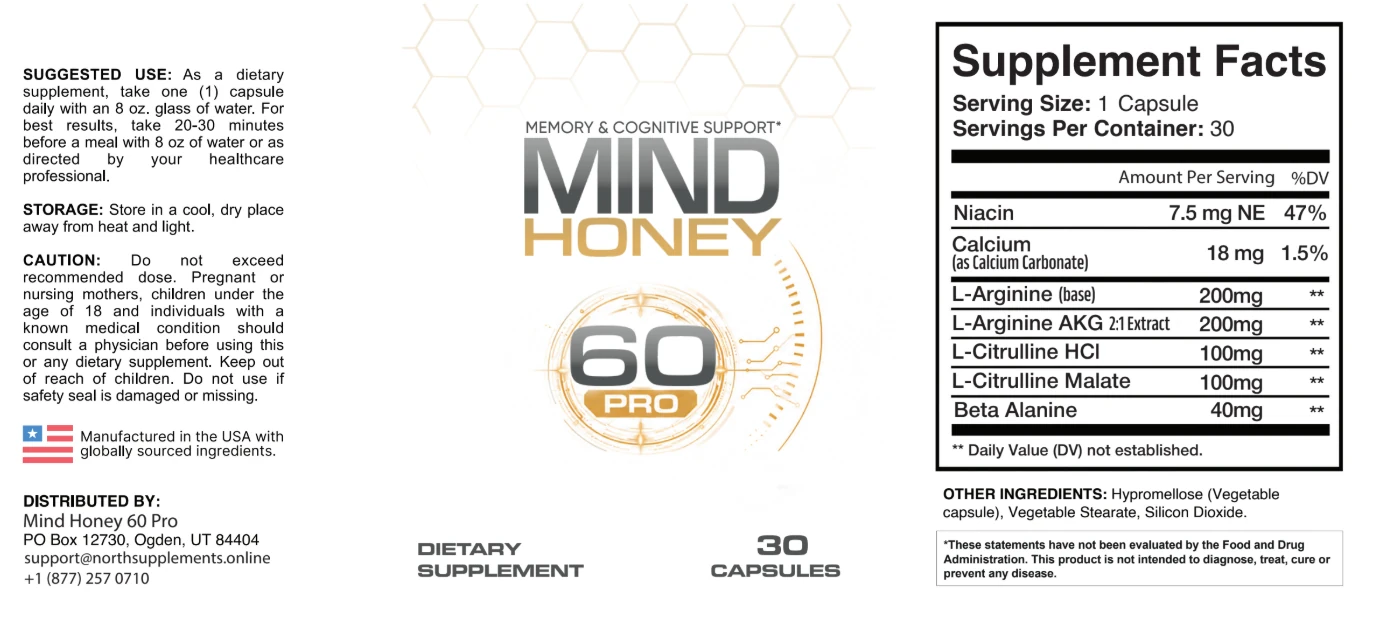
- This panel's seven printed amounts add up to 665.5 mg of combined active ingredient in a single capsule, before any capsule shell or flow agent is counted.
- A widely used 00-size capsule, one of the largest sizes routinely used in supplements, holds roughly 735 mg of typical powder blend by volume, which leaves a narrow margin once excipients are added to that 665.5 mg of actives.
- Research on older adults found the visually acceptable size limit for a swallowed tablet sits around 250 mg, and that capsules were rated worse than tablets of comparable weight, meaning a capsule holding many actives works against ordinary swallowing comfort by design.
- A scoping review of drug-product attributes found swallowability and size are the two factors patients weigh most heavily when judging whether a pill is acceptable to take.
- Separately, research on pill burden in other conditions has found that each additional pill in a daily regimen measurably reduces how consistently people take their medication, which is part of why formulators try to consolidate several actives into one capsule rather than several.
- None of this is a defect specific to this product. It is the same physical and behavioural trade-off every multi-ingredient capsule in this category is built around.
Adding the panel up
Read the Supplement Facts panel as seven separate rows and each amount looks small on its own: 7.5 mg of niacin, 18 mg of calcium, 200 mg of L-arginine base, 200 mg of L-arginine AKG extract, 100 mg of L-citrulline HCl, 100 mg of L-citrulline malate, and 40 mg of beta alanine. Add them together, as nothing on the label itself does, and the total is 665.5 mg of combined active ingredient in a single capsule, before the capsule shell, or any binding and flow agent, is counted at all.
The panel itself lists the actives; the shell is hypromellose, and vegetable stearate and silicon dioxide sit underneath as the other ingredients that help the powder flow and hold together, covered in the article on those three linked below. All of that, active and inactive alike, has to occupy the same physical space inside one swallowed capsule.
| Row | Amount | Share of the 665.5 mg total |
|---|---|---|
| L-Arginine (base) | 200 mg | 30.1% |
| L-Arginine AKG 2:1 Extract | 200 mg | 30.1% |
| L-Citrulline HCl | 100 mg | 15.0% |
| L-Citrulline Malate | 100 mg | 15.0% |
| Beta Alanine | 40 mg | 6.0% |
| Calcium (as Calcium Carbonate) | 18 mg | 2.7% |
| Niacin | 7.5 mg NE | 1.1% |
The four amino-acid rows alone, arginine and citrulline in their two forms each, take up 90.2% of the capsule's active weight. The mineral and vitamin rows, by comparison, barely register on the same scale.
What a capsule actually holds
Capsules are manufactured in standard sizes, and 00 is one of the largest sizes routinely used in oral supplements and medicines before a formula moves to a two-capsule serving or a tablet instead. A 00 capsule's internal volume holds roughly 735 mg of a typical powder blend, though the exact figure shifts with how densely a particular powder blend packs.
Against that ceiling, 665.5 mg of actives alone leaves a genuinely narrow margin for the shell-lubricating and anti-caking agents a seven-ingredient blend needs to flow evenly into each capsule during manufacturing. That narrow margin is a real formulation constraint, not a marketing detail, and it is the kind of arithmetic that happens once, at the design stage, long before a bottle reaches a shelf.
Why five of these rows are milligrams, not grams
A separate article on this site covers why this panel's arginine row sits in milligrams while the cognition trials behind it used grams, from the dosing-and-evidence side. The volume math here is the other half of that same story. Five of this panel's seven rows are amino acids that, in isolated supplement form, are typically dosed by the gram when a formula is built around just one or two of them. This panel carries five amino-acid rows plus a mineral and a vitamin row at once, inside a single capsule that also has to swallow easily.
A single-ingredient product with room to spend its entire capsule volume on one amino acid can print a gram-scale number. A seven-ingredient product dividing roughly 700 mg of usable capsule space across seven rows arrives at milligram-scale numbers for most of them by physical necessity, independent of what any individual ingredient's own research literature would consider an ideal dose. That is a real constraint worth naming plainly, and it sits alongside, rather than instead of, the dosing comparisons the other article covers.
Order Mind Honey Pro with the volume math already done
Seven rows, one capsule, and a real physical ceiling behind how much of each row could ever fit. The panel prints the result; this article prints the constraint behind it.
Two bottles $158 · six bottles $294 · 180-day money-back guarantee
Order Mind Honey ProOne capsule a day · 30 per bottle
What size does to swallowing comfort
A 2023 study in Pharmaceutics tested how 52 older adults (65 to 94) and 52 younger adults (19 to 36) judged the swallowability of tablets and capsules ranging from 125 mg to 1,000 mg in weight, based on visual perception before actually swallowing anything. For older adults, the acceptable size limit was reached at around 250 mg; the smallest tablets tested were rated worst, but capsules performed worse than tablets across the board. The study also found a clear pattern of self-underestimation: people judged their own swallowing ability more conservatively than their actual measured performance, tested separately in the same group, supported.
A related 2016 study of 156 older patients found 11% displayed symptoms consistent with swallowing difficulty, and that group in particular rated large tablets and 00-size capsules as harder to manage than smaller or non-solid forms. A 2024 scoping review of nineteen studies on drug-product acceptability identified swallowability and size as the single most-studied, and most consequential, pair of factors patients weigh when judging whether they are willing to keep taking a given pill.
Why one capsule instead of several
The alternative to one large capsule is more, smaller ones, and that trade has its own research literature under the heading of pill burden. A 2019 study of 9,815 hepatitis C patients found that mean overall pill burden, counting every medication a patient took, not just the hepatitis C treatment, rose from 5.4 pills a day before treatment to 7.7 after. As the number of daily hepatitis C pills specifically rose from one to two to three or more, the adjusted odds of a gap of fifteen days or more in treatment rose from a baseline of one, to 1.75 at two pills a day, to 2.11 at three or more, more than doubling.
A separate, non-systematic review of intentional non-adherence in older adults reached a similar point from a different direction. It lists regimen complexity and poly-pharmacy, more pills, more separate decisions to take each one, as one of six recurring factors behind people quietly choosing not to follow a regimen exactly as prescribed, distinct from simply forgetting, alongside beliefs about the medicine, perceived risks and benefits, and the relationship with whoever prescribed it. Neither study is about supplements specifically, but the mechanism, more discrete pills meaning more discrete chances to skip one, is a general property of any regimen, not a finding unique to prescription drugs.
Set against that literature, consolidating seven actives into one daily capsule, rather than three or four smaller capsules with the same total content, is a defensible design choice on adherence grounds, even though it is also the choice that pushes the single capsule toward the upper edge of what a 00 shell can comfortably hold and what the swallowability research above found older adults rate well. There is no research cited here that tested this specific trade-off for this specific product; the point is that the trade-off itself, fewer larger pills against more smaller ones, is real and goes in both directions at once.
The arithmetic, side by side
| Figure | Amount | Source |
|---|---|---|
| This panel's seven actives, combined | 665.5 mg | Added from the label's own printed rows |
| Typical 00 capsule fill volume | ≈735 mg of powder blend | Standard encapsulation reference for this capsule size |
| Visually acceptable tablet size, older adults | ≈250 mg | 2023, Pharmaceutics |
| Adherence gap at 3+ pills/day vs. 1 | More than double the odds | 2019, Curr Med Res Opin |
Every row in this table is pulling in a slightly different direction, and one capsule is where they all had to be reconciled.
Why this panel didn't simply choose a smaller number of actives
An obvious alternative to the volume constraint described above would be fewer ingredients at higher individual doses, closer to what the research behind any single one of them used. That is a real option, and it is the option a single-ingredient product takes. It is also a different product with a different premise: this panel's own case, covered in the articles on its ingredients page, is built on carrying all seven rows from the label's named list together in one daily capsule, not on maximizing any one row in isolation. The volume math above is the physical reason that trade-off pushes toward milligram-scale amounts rather than the gram-scale amounts a single-ingredient product can afford; it is not a comment on which approach is preferable, only an explanation of why this one looks the way it does.
What this means for reading the panel
None of this changes what any individual row does, and none of it is a claim that a different capsule count or a different set of doses would work better; that is a formulation decision, not a finding from any of the research cited here, which studied swallowing acceptability and pill burden in general, not this product specifically. What it does add is a plain, checkable reason behind a pattern a careful reader will already have noticed on this panel: five milligram-scale amino-acid rows sharing one capsule with a mineral and a vitamin row, inside a shell that has a real, physical ceiling. The rows are shaped the way they are partly because of what the ingredients themselves are for, and partly because of what fits.
References
- Liu F, Ghaffur A, Bains J, Hamdy S. Acceptability of oral solid medicines in older adults with and without dysphagia: A nested pilot validation questionnaire based observational study. Int J Pharm. 2016;512(2):374-381. PMID 26970368. https://pubmed.ncbi.nlm.nih.gov/26970368/
- Hummler H, Page S, Stillhart C, Meilicke L, Grimm M, Mannaa M, Gollasch M, Weitschies W. Influence of Solid Oral Dosage Form Characteristics on Swallowability, Visual Perception, and Handling in Older Adults. Pharmaceutics. 2023;15(4):1315. PMID 37111799. https://pubmed.ncbi.nlm.nih.gov/37111799/
- Hauber B, Hand MV, Hancock BC, Zarrella J, Harding L, Ogden-Barker M, Antipas AS, Watt SJ. Patient Acceptability and Preferences for Solid Oral Dosage Form Drug Product Attributes: A Scoping Review. Patient Prefer Adherence. 2024;18:1281-1297. PMID 38919378. https://pubmed.ncbi.nlm.nih.gov/38919378/
- An J, Lee JS, Sharpsten L, Wilson AK, Cao F, Tran JN. Impact of pill burden on adherence to hepatitis C medication. Curr Med Res Opin. 2019;35(11):1937-1944. PMID 31298592. https://pubmed.ncbi.nlm.nih.gov/31298592/
- Mukhtar O, Weinman J, Jackson SH. Intentional non-adherence to medications by older adults. Drugs Aging. 2014;31(3):149-57. PMID 24566876. https://pubmed.ncbi.nlm.nih.gov/24566876/