Mind Honey Pro Official Website › Blog › The Eight Ounces Of Water
The Eight Ounces Of Water On The Label: Capsules, Hydration And Clear Thinking
The instruction on the left of the label mentions water twice. It is easy to read past, because it sounds like the sort of thing every pill bottle says. But an eight-ounce glass is a real quantity with real research behind it, and the research is more interesting than the instruction. It covers two separate jobs for that glass: getting a capsule down properly, and whatever hydration does for the way you think. On the second, the studies disagree, and it is worth seeing exactly how.
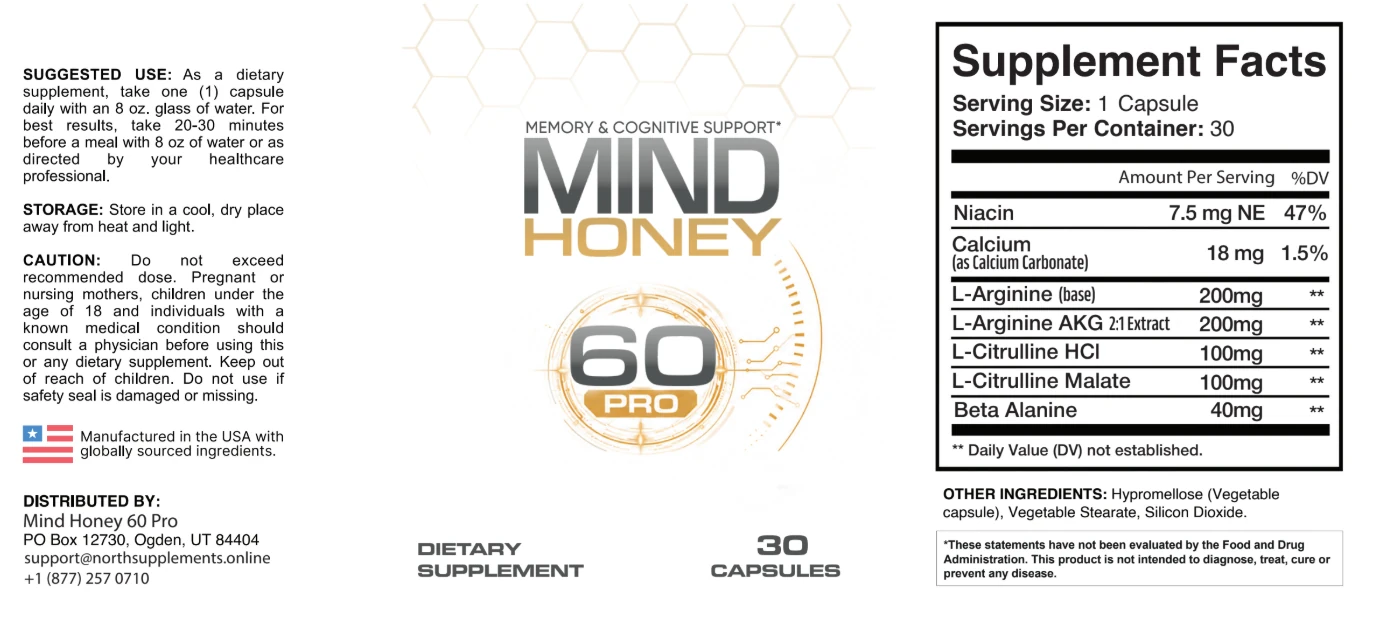
- The label asks for one capsule daily with an 8 oz glass of water, and repeats it: 20 to 30 minutes before a meal with 8 oz of water, or as directed by a healthcare professional. Eight US ounces is about 237 ml.
- In a 1982 radiological study of 121 volunteers, 22% of 726 swallowings of common tablets and capsules failed to clear the gullet within 90 seconds. It recommended at least 100 ml of water.
- Two meta-analyses of dehydration and cognition disagree. One found a small significant impairment, mostly of attention and executive function. The other found no significant impairment, memory domains included.
- A study of mild dehydration in 25 young women found worse mood, more difficulty concentrating and more headache at about 1.4% body-mass loss, but most cognitive tests were unchanged.
- In adults aged 55 to 75, lower hydration by blood osmolarity was linked to a larger two-year decline in cognition. Reported water intake was not.
- One glass is about 8% of the total water intake seen in that cohort. It is a swallowing measure and a routine cue, not a hydration plan.
What the label actually says
Read the Suggested Use block on the label artwork and the wording is this: take one (1) capsule daily with an 8 oz. glass of water. For best results, take 20-30 minutes before a meal with 8 oz of water or as directed by your healthcare professional. Water appears twice, which is unusual, and both times it is quantified.
Eight US fluid ounces is about 237 millilitres, a little under a quarter of a litre. The label gives it as a volume and never explains it. The how-to-use page covers the routine, including the timing before a meal. This article asks a narrower question, which is what the science says about a glass of water taken with a capsule.
There are two possible jobs for that glass. One is mechanical: getting a capsule from the mouth to the stomach without incident. The other is physiological: keeping you hydrated, and whatever hydration does for thinking. They deserve separate answers, because the evidence for them is very different.
Job one: getting the capsule down
The oldest useful paper on this is a 1982 study in the British Medical Journal. It followed the oesophageal transit of six commonly used tablets and capsules, each containing barium sulphate, by fluoroscopy in 121 healthy volunteers. Each swallowed three preparations while lying down and while standing, and with 25 ml or 100 ml of water.
The results are not what most people would guess.
- Failure of swallowing, defined as oesophageal transit taking more than 90 seconds, occurred in 22% of 726 swallowings.
- Only 33% of those failures came with a complaint of globus, the sensation of something stuck. In other words two failures in three came with no such complaint.
- Sixty per cent of the volunteers had difficulty with one or more of the preparations.
- Many preparations adhered to the oesophageal lining and began to disintegrate in the lower oesophagus.
- Small tablets were swallowed most easily.
The authors recommended that people stay standing for at least 90 seconds after taking a capsule or tablet, and that every preparation should be taken with at least 100 ml of water.
Set the glass on the label beside that. Eight ounces is about 237 ml, more than twice the 100 ml the authors recommended as a minimum, and nearly ten times the smaller volume in their test. So on this job the label sits on the generous side of the paper’s minimum, and the paper suggests that swallowing a capsule with a mouthful, or none, is more error-prone than it feels.
The study is 44 years old and used barium-containing tablets and capsules of six common types, not this one. It is evidence about how capsules behave in the gullet in general, not a test of Mind Honey Pro, and it supports the idea behind the instruction and is not a finding about the product.
Staying on your feet for a minute and a half afterwards is the second half of the paper’s advice, and it costs nothing. Taking it with a glass of water at the breakfast table, then carrying on with the morning, is the natural version of it.
Job two: does hydration change how you think?
This is where a healthy reader should expect a clean answer and will not get one. Two well-conducted meta-analyses looked at the same broad question and reached different conclusions.
The meta-analysis that found an effect
A 2018 meta-analysis in Medicine and Science in Sports and Exercise pooled 33 studies with 413 subjects, in which dehydration ranged from 1% to 6% of body mass. Overall, dehydration impaired cognitive performance by a small but significant amount (effect size −0.21, interval −0.31 to −0.11). The impairment was largest for attention (−0.52), then motor coordination (−0.40) and executive function (−0.24). Simple reaction time was not clearly affected. When body-mass loss was over 2%, the effect was larger (−0.28) than at or below 2% (−0.14, with an interval that just reached zero).
The meta-analysis that did not
A 2019 meta-analysis in Physiology and Behavior examined active hypohydration and found that cognitive performance was not significantly impaired overall (g = −0.177, interval −0.532 to 0.179). It looked at the domains of complex attention, executive function, and learning and memory, and found no significant impairment in any of them, whether the fluid loss was under or over 2% of body mass. The authors concluded that recommendations to avoid moderate dehydration on the grounds of cognition were not substantiated.
A systematic review that shrugs
A 2021 systematic review of hydration and executive function covered 33 studies and 3,636 participants. It found little consistency: roughly half the studies suggested unclear or neutral effects, and half suggested effects on domains including working memory, inhibitory control and attention. Studies that included a hydrated condition were slightly more likely to show improvements. The reviewers called for more consistent methods and more studies longer than three days.
| Source | What it pooled | Headline |
|---|---|---|
| 2018 meta-analysis | 33 studies, 413 subjects, 1% to 6% body-mass loss | Small significant impairment. Attention, executive function and motor coordination hit most. |
| 2019 meta-analysis | Active hypohydration, including learning and memory | No significant impairment overall or in any domain. |
| 2021 systematic review | 33 studies, 3,636 participants | About half neutral or unclear, about half showing effects. |
Three reviews, three verdicts, and no clean answer. That is an honest description of where the field stands.
How could reasonable reviews disagree? The most likely answer is that they pooled different studies, with different ways of making people dehydrated, different tasks and different amounts of fluid loss, and the papers themselves note that methods varied. A person who has read only one of them would come away confident and wrong about the other.
One more piece of context is helpful for scale. Two per cent of body mass in a 70 kg (154 lb) adult is 1.4 kg, about 3 lb of water. In the trials, losses of that size were produced deliberately, by methods that varied, and the mildest study below reached 1.36%. That is worth remembering when a headline says hydration and thinking are linked.
What mild dehydration seems to do
The most useful single study for an ordinary person is a randomized trial of mild dehydration in 25 healthy young women. They took part in three 8-hour experiments in different hydration states, using moderate exercise, with and without a diuretic, against a hydrated control. Mean dehydration on the dehydrated days was 1.36% of body mass.
Mood suffered: vigour was lower, fatigue higher and total mood disturbance worse. Participants reported tasks as more difficult, concentration as poorer and headache as more frequent. Most aspects of cognitive performance, however, were not affected. So the effect was on how it felt to do the tasks more than on how well they were done.
That pattern, effort and mood before performance, is easy to mistake for a memory problem, and it is the kind of change a memory-capsule tester is at risk of mislabelling. Feeling foggy at three in the afternoon is not a verdict on anything, least of all a supplement.
Older adults: thirst runs quieter
Some of this literature matters more with age, and the readers of a memory-support product are mostly not young.
A small physiology paper, a 1997 study of thirst and ageing, dehydrated six older subjects (mean age 70) and six younger ones (mean age 24). Before immersion, the older group rated their thirst lower, at 69 mm on a line scale against 94 mm for the younger group, despite similar rises in blood osmolality. The authors concluded that the inhibitory influence of central volume expansion on thirst and drinking is diminished with ageing. It is only twelve people, but it fits a familiar idea: the signal to drink gets quieter.
Bigger studies are observational. A 2021 systematic review of dehydration in older people covered 18 papers and 33,707 people aged 60 and over. Dehydration was linked to higher mortality, worse illness courses and higher costs, and there was, in its words, some but sparse evidence that it was linked to poorer cognitive performance.
A 2023 cohort study gives the most direct numbers. It followed 1,957 adults aged 55 to 75 with overweight or obesity and metabolic syndrome. Their mean total water intake was 2,871 ml a day, and 80.2% met the European reference values for adequate intake. Yet by serum osmolarity, 56% were physiologically dehydrated. Worse hydration status was associated with a bigger decline in global cognitive function over two years (β −0.010, interval −0.017 to −0.004). Water intake itself, from drinks or food, was not significantly associated with cognitive change.
Read that carefully. It is an association in one particular group, not proof that water changes thinking. And the odd result, that reported intake did not track cognition though osmolarity did, is a reminder that what people say they drink is not the same as their hydration.
Order Mind Honey Pro with the glass of water already explained
One capsule a day, thirty to a bottle, an 8 oz glass of water as the label directs, and 180 days from the date of purchase to change your mind. The water is the cheapest part of the routine to get right.
Two bottles $158 · six bottles $294 · 180-day money-back guarantee
Order Mind Honey Pro On The Official WebsiteOne capsule a day · 30 per bottle · lot MIN-26/TH-5324
How much a single glass amounts to
Now put the label’s glass in proportion. In that 2023 cohort the mean total water intake was 2,871 ml a day, from all drinks and all food. One 8 oz glass is about 237 ml. Divided out, it comes to about 8% of the daily total that group was already taking in.
The arithmetic does not diminish the instruction. It clarifies what the instruction is. The glass on the label is a swallowing measure, backed by the 1982 paper. It is also a cue, a small fixed ritual that ties a capsule to a moment in the day, which the article on the daily habit explores. It is not a hydration programme, and nobody should treat a capsule-sized glass as the reason they are or are not thinking clearly.
If swallowing capsules is not easy
For most readers the glass of water is a courtesy. For some it is not, and it is worth saying where the line is.
The 1982 study found that 60% of healthy volunteers had difficulty with at least one preparation, so occasional trouble is common and usually harmless. A different situation is described in a 2015 video-endoscopy study of 52 patients with stroke-induced dysphagia, which found that 40.4% had severe difficulty swallowing solid dosage forms with thickened water and 43.5% with milk, and that swallowing a capsule or tablet raised their risk of penetration and aspiration. The study also found that neither the patients’ own judgement nor routine bedside tests reliably identified who was at risk.
That is a very different population from the healthy adults this product is meant for, and it is cited only for its practical lesson. Trouble swallowing that is persistent, painful, or new is a reason to speak to a doctor or pharmacist, and the fix is not a bigger glass. Nothing about this bottle should be forced down.
What to do with all this
- Take the capsule with the full glass. The swallowing evidence supports it, and it is the one part of this article that the label already asks for.
- Stay upright afterwards. The 1982 authors recommended standing for at least 90 seconds. A morning routine already does that.
- Tell someone if swallowing is a problem. Persistent difficulty is a matter for a doctor or pharmacist.
- Keep the 20 to 30 minute window as written. The calcium article covers why the timing and the chemistry pull slightly against each other, and why at 18 mg it does not matter.
- If a clinician has set a limit on how much you drink, that limit governs. One of the hydration reviews above excluded studies of people with conditions that need fluid restriction, and the label itself allows the instruction to be varied as directed by a healthcare professional.
- Treat hydration as another item on the confounder list. A dry, foggy afternoon and a poor night both make memory feel worse. The sleep article is the bigger one.
If you are older and rarely feel thirsty, the studies above give a reason to make drinking a scheduled event rather than a response to a signal. The capsule’s glass is one scheduled drink a day, and this desk is not suggesting it is enough by itself.
The line this article will not cross
None of the papers here tested Mind Honey Pro, and none tested a glass of water taken with it. The 1982 study is about how capsules travel. The hydration papers are about dehydration and thinking in general, in groups that mostly were not taking this product. Their conclusions disagree with each other.
What the label asks for is straightforward and sensible: a full glass, a capsule, a gap before eating. What the research adds is some reasons behind it and a fair warning that hydration is a small and uncertain lever on thinking, and not one to lean on when you judge a supplement.
Mind Honey Pro is a dietary supplement for healthy adults of eighteen and over, not a drug, and it is not FDA-approved. It is not intended to diagnose, treat, cure or prevent any disease. Nothing above is advice on how much anyone should drink. People with heart, kidney or other conditions that affect fluid balance, or on fluid limits, should follow their clinician’s instructions, and anyone who has trouble swallowing capsules should speak to a pharmacist or doctor.
References
- Hey H, Jørgensen F, Sørensen K, et al. Oesophageal transit of six commonly used tablets and capsules. Br Med J (Clin Res Ed). 1982;285(6356):1717-9. PMID 6816343. https://pubmed.ncbi.nlm.nih.gov/6816343/
- Wittbrodt MT, Millard-Stafford M. Dehydration Impairs Cognitive Performance: A Meta-analysis. Med Sci Sports Exerc. 2018;50(11):2360-2368. PMID 29933347. https://pubmed.ncbi.nlm.nih.gov/29933347/
- Goodman SPJ, Moreland AT, Marino FE. The effect of active hypohydration on cognitive function: A systematic review and meta-analysis. Physiol Behav. 2019;204:297-308. PMID 30876770. https://pubmed.ncbi.nlm.nih.gov/30876770/
- Katz B, Airaghi K, Davy B. Does Hydration Status Influence Executive Function? A Systematic Review. J Acad Nutr Diet. 2021;121(7):1284-1305.e1. PMID 33547031. https://pubmed.ncbi.nlm.nih.gov/33547031/
- Armstrong LE, Ganio MS, Casa DJ, et al. Mild dehydration affects mood in healthy young women. J Nutr. 2012;142(2):382-8. PMID 22190027. https://pubmed.ncbi.nlm.nih.gov/22190027/
- Stachenfeld NS, DiPietro L, Nadel ER, et al. Mechanism of attenuated thirst in aging: role of central volume receptors. Am J Physiol. 1997;272(1 Pt 2):R148-57. PMID 9039003. https://pubmed.ncbi.nlm.nih.gov/9039003/
- Edmonds CJ, Foglia E, Booth P, et al. Dehydration in older people: A systematic review of the effects of dehydration on health outcomes, healthcare costs and cognitive performance. Arch Gerontol Geriatr. 2021;95:104380. PMID 33636649. https://pubmed.ncbi.nlm.nih.gov/33636649/
- Nishi SK, Babio N, Paz-Graniel I, et al. Water intake, hydration status and 2-year changes in cognitive performance: a prospective cohort study. BMC Med. 2023;21(1):82. PMID 36882739. https://pubmed.ncbi.nlm.nih.gov/36882739/
- Schiele JT, Penner H, Schneider H, et al. Swallowing Tablets and Capsules Increases the Risk of Penetration and Aspiration in Patients with Stroke-Induced Dysphagia. Dysphagia. 2015;30(5):571-82. PMID 26205435. https://pubmed.ncbi.nlm.nih.gov/26205435/