Mind Honey Pro Official Website › Blog › Ingredients This Panel Doesn't Use
The Ingredients Other Memory Formulas Use That This One Doesn't
Ginkgo biloba and Bacopa monnieri are the two most heavily studied plant ingredients in the entire memory-support category, appearing on far more competing labels than this one. Neither is printed on this panel. Before comparing formulas on that basis, it is worth reading what the actual trial evidence behind each of those two ingredients says, because the honest answer is more nuanced than either name being a guarantee of anything.
- The newest Cochrane review of Ginkgo biloba, updated in 2026 and covering 82 studies and over 10,000 participants, found effects that vary sharply by who is taking it: uncertain in people with subjective complaints, little to no effect in mild cognitive impairment, and small-to-moderate benefit in diagnosed dementia.
- An earlier 2015 meta-analysis of the same standardized Ginkgo extract at 240 mg/day, across nine trials and 2,561 patients with cognitive impairment or dementia, found favourable effects on cognition and daily function with no important safety concerns, at that specific dose and in that specific population.
- A randomized trial of Bacopa monnieri in 54 healthy older adults found improved delayed word recall and Stroop test performance after twelve weeks, against a placebo group that did not improve.
- A 2026 network meta-analysis comparing Bacopa and Ginkgo head-to-head across 29 trials found high-dose Bacopa (600 mg/day or more) outperformed both low- and high-dose Ginkgo for working memory in healthy adults, while cautioning that direct comparisons remain limited.
- Neither botanical is on this panel, and nothing here is a comment on Mind Honey Pro's own formula. It is what the category's two most common competing ingredients have and have not been shown to do.
Why this matters before comparing labels
Walk down any shelf of memory-support products and Ginkgo biloba or Bacopa monnieri appears on a large share of them. Neither appears on this one. That is worth pausing on before treating either name as a checklist item, because both botanicals have been studied for decades, by some of the most rigorous review bodies in medicine, and the honest verdict on both is more qualified than either a bottle that includes them or a bottle that doesn't would suggest on its own.
Ginkgo biloba: what the newest Cochrane review found
The most current word on Ginkgo is a Cochrane systematic review updated in 2026, covering searches through November 2024. Cochrane reviews are widely treated as the strictest tier of evidence synthesis in medicine, because of how they weigh trial quality rather than simply pooling results. This one included 82 studies and 10,613 participants, comparing Ginkgo against placebo across four different clinical groups.
The findings differed sharply by group. In people with subjective cognitive complaints but no diagnosis, it was uncertain whether Ginkgo had any effect on global clinical status, and a larger study found the risk of adverse events may be higher with Ginkgo than placebo. In multiple sclerosis with cognitive problems, Ginkgo probably had little or no effect. In mild cognitive impairment, moderate-certainty evidence found little to no effect on global status, cognition or daily activities. In diagnosed dementia specifically, the picture flipped: low-certainty evidence suggested Ginkgo users had better global clinical status, better cognition and slightly better daily-activity scores than placebo, with no meaningful difference in serious adverse events.
The review's own summary is careful, not a simple yes or no: uncertain benefit in subjective complaints and MCI, possible small-to-moderate benefit specifically in dementia. That nuance rarely survives onto a bottle's front label.
An earlier meta-analysis, at one specific dose
A 2015 meta-analysis in the Journal of Alzheimer’s Disease looked more narrowly at one standardized extract, EGb761, across nine trials and 2,561 patients with cognitive impairment or dementia, all running 22 to 26 weeks. At a dose of 240 mg a day, it found favourable effects on cognition scores, daily-living activities, and clinical global impression, with the benefit strongest in patients who also had neuropsychiatric symptoms. Safety data across the pooled trials showed no important concerns at that dose.
Read the two reviews together and a pattern holds: where Ginkgo shows a benefit in the literature, it tends to be a specific extract, at a specific and fairly high dose, in a specific diagnosed population, over a period of months, not a general property of the plant at any amount for any user.
Order Mind Honey Pro for what its own panel does, not what it leaves out
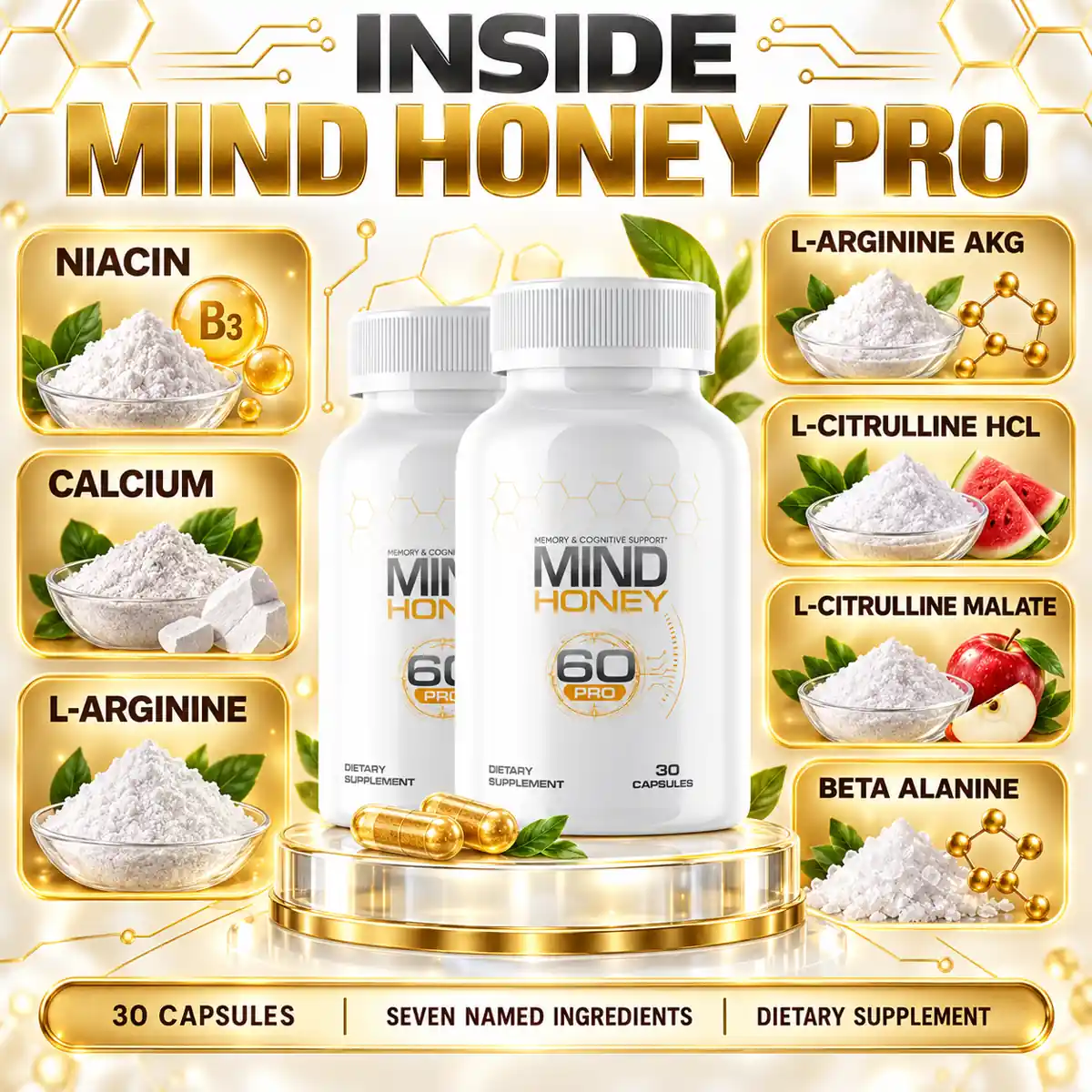
This formula's case rests on the seven amounts printed on its own label, covered in full elsewhere on this site. Ginkgo and Bacopa are a different case, with a different evidence base, covered here on their own terms.
Two bottles $158 · six bottles $294 · 180-day money-back guarantee
Order Mind Honey ProOne capsule a day · 30 per bottle
Bacopa monnieri: a twelve-week trial in older adults
Bacopa's best-known human trial is a randomized, double-blind, placebo-controlled study published in the Journal of Alternative and Complementary Medicine in 2008. Fifty-four adults aged 65 and older, none showing clinical signs of dementia, were randomized to a standardized Bacopa extract at 300 mg/day or placebo, after a six-week placebo run-in, for twelve weeks of active treatment.
The Bacopa group showed enhanced delayed-recall memory scores on a standard verbal learning test relative to placebo, and improved performance on the Stroop task, a measure of the ability to ignore irrelevant information, while the placebo group did not improve on either. Depression and anxiety scores also improved more in the Bacopa group. No effect was found on a divided-attention task, a working-memory digit test, or blood pressure. Adverse events were mostly mild stomach upset, at similar rates in both groups. The trial's own conclusion was that this provides further evidence Bacopa has potential for safely enhancing cognitive performance in aging, phrased as potential rather than proof.
A 2026 study that compared the two directly
Most Bacopa and Ginkgo research has run separately, which makes a 2026 network meta-analysis in Phytomedicine unusual: it searched specifically for trials of either botanical in healthy adults and analysed them together, covering 29 randomized trials and 2,107 participants.
High-dose Bacopa, defined as 600 mg/day or more, significantly outperformed low-dose Bacopa, high-dose Ginkgo, low-dose Ginkgo, and placebo for working memory, and also showed greater benefit for short-term memory. For delayed memory specifically, even low-dose Bacopa outperformed low-dose Ginkgo and placebo. No significant differences turned up between the two botanicals for sustained attention, selective attention, or processing speed. The authors' own conclusion favoured high-dose Bacopa as the more promising of the two in healthy adults, while explicitly flagging that the lack of head-to-head trials, as opposed to indirect statistical comparison, limits how much weight that conclusion can bear.
Both botanicals, side by side
| Ingredient | Strongest evidence | What it showed |
|---|---|---|
| Ginkgo biloba (EGb761, 240 mg/day) | 2015 meta-analysis, 2,561 patients, dementia/MCI | Favourable cognition and function effects, strongest with neuropsychiatric symptoms present. |
| Ginkgo biloba, all populations | 2026 Cochrane review, 10,613 participants | Effect depends heavily on population; uncertain in subjective complaints and MCI, small-to-moderate in dementia. |
| Bacopa monnieri (300 mg/day) | 2008 RCT, 54 adults 65+ | Improved delayed recall and Stroop performance over 12 weeks; no effect on divided attention. |
| Bacopa vs. Ginkgo, healthy adults | 2026 network meta-analysis, 2,107 participants | High-dose Bacopa outperformed both Ginkgo doses for working memory; no direct head-to-head trials exist. |
Both ingredients have real trial support. Both also have real limits on who was studied, at what dose, and for how long.
Why absence from a panel is not automatically a flaw
None of the research above is a criticism of this product, and none of it is a claim that adding either botanical would improve it; no trial cited here tested Mind Honey Pro. A formula is a set of trade-offs: every row included is a row someone chose to fund, dose and test for interactions with the rest of the panel, and every row left out is one fewer variable competing for space, cost and potential interaction inside a single capsule. This panel's own seven rows, and the specific case for each of them, are covered in the articles linked below; that case stands or falls on its own evidence, not on whether it matches a competitor's ingredient list.
It is also worth noting what the Cochrane review's adverse-event data actually showed for Ginkgo, since a botanical is sometimes assumed to be safer by default than a synthesized or standardized amino acid simply for being a plant extract. In people with subjective cognitive complaints, one larger trial found the risk of adverse events may be higher with Ginkgo than with placebo. Across the dementia trials, there was probably little or no difference in adverse events at up to twelve months, and little or no difference in serious adverse events. That is a normal, unremarkable safety profile for a studied botanical extract, not evidence of unusual risk, but it is also not a free pass; every ingredient in this category, plant-derived or not, carries its own specific evidence base rather than a general reputation.
Where the doses in this research sit
It is worth being specific about scale here, the same way this site is specific about its own panel's amounts. The Ginkgo benefit described above appeared at 240 mg/day of a standardized extract called EGb761, in trials running 22 weeks or longer. The Bacopa benefit described above appeared at 300 mg/day over twelve weeks in one trial, and specifically at 600 mg/day or higher in the 2026 comparison across 29 trials. Both are single-ingredient doses, arrived at through their own dedicated research programs over several decades, in each case for one botanical occupying its own capsule or tablet rather than sharing space with six other actives.
What to actually look for when comparing formulas
- Ask which population a cited study actually used. Ginkgo's own evidence looks very different in diagnosed dementia than in healthy adults with no complaints.
- Ask what dose the study used, and compare it to what is actually on the label in front of you. The Ginkgo benefit above appeared at 240 mg/day of one specific standardized extract; the Bacopa benefit above appeared at 300 to 600+ mg/day.
- Ask how long the trial ran. Both the Ginkgo and Bacopa studies above ran twelve weeks or longer; nothing in this category has shown a reliable effect in days.
- A name on an ingredient list is not the same as a dose-matched, population-matched trial behind that specific product. That distinction applies equally to every formula in this category, including this one.
References
- Wieland LS, Ludeman E, Chi Y, et al. Ginkgo biloba for cognitive impairment and dementia. Cochrane Database Syst Rev. 2026;2(2):CD013661. PMID 41641880. https://pubmed.ncbi.nlm.nih.gov/41641880/
- Tan MS, Yu JT, Tan CC, Wang HF, Meng XF, Wang C, Jiang T, Zhu XC, Tan L. Efficacy and adverse effects of ginkgo biloba for cognitive impairment and dementia: a systematic review and meta-analysis. J Alzheimers Dis. 2015;43(2):589-603. PMID 25114079. https://pubmed.ncbi.nlm.nih.gov/25114079/
- Calabrese C, Gregory WL, Leo M, Kraemer D, Bone K, Oken B. Effects of a standardized Bacopa monnieri extract on cognitive performance, anxiety, and depression in the elderly. J Altern Complement Med. 2008;14(6):707-13. PMID 18611150. https://pubmed.ncbi.nlm.nih.gov/18611150/
- Tiemtad P, Ingkaninan K, Temkitthawon P, Thimkorn P, Rattanachaisit N, Teaktong T, Dhippayom T. Comparative effects of Bacopa monnieri and Ginkgo biloba on cognitive functions: A systematic review and network meta-analysis. Phytomedicine. 2026;153:157915. PMID 41678913. https://pubmed.ncbi.nlm.nih.gov/41678913/